A Name Is Not a Thing: What Peebles Actually Said About the Dark 95 Percent
24 September 2026
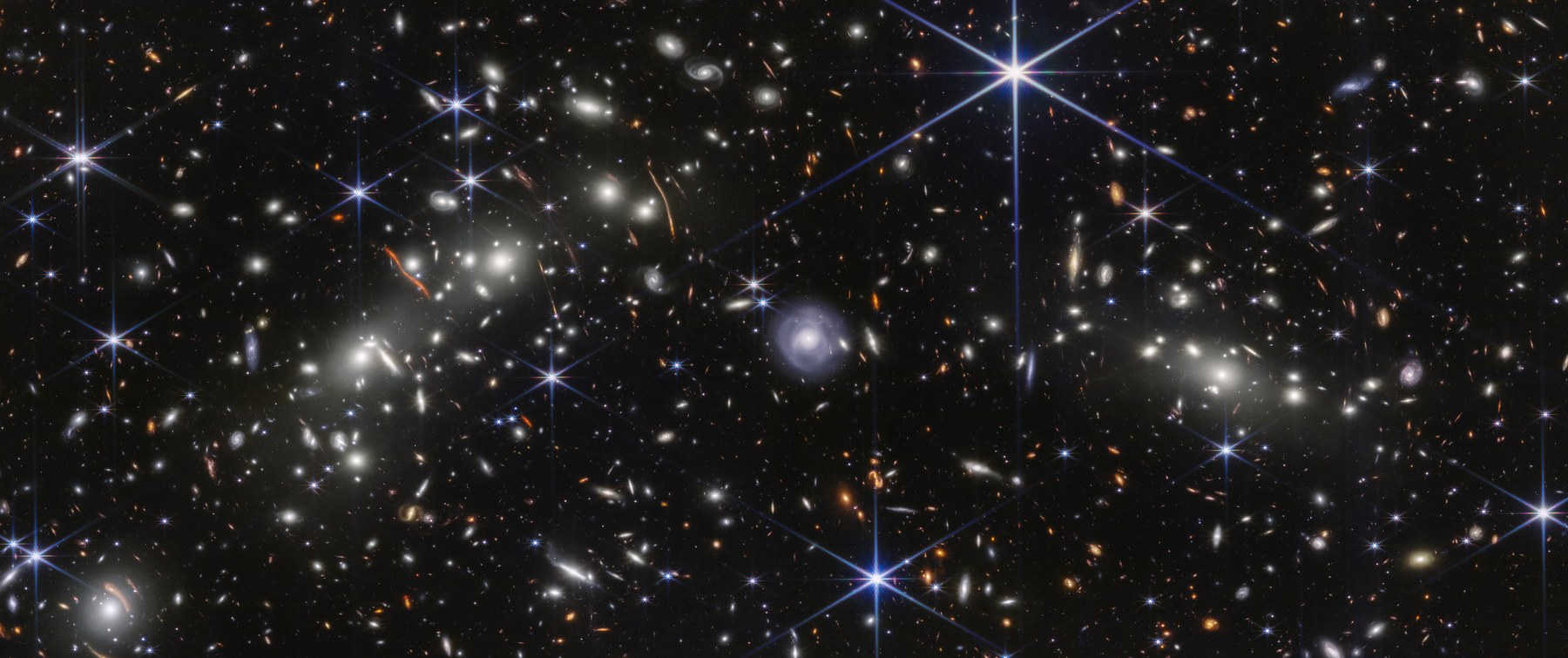 The Bullet Cluster, two clusters of galaxies that passed through each other, in Webb’s near-infrared view. Separate X-ray and lensing maps, not shown here, put most of the ordinary matter and most of the mass in different places. Photo: NASA, ESA, CSA, STScI, J. Jee (Yonsei University, UC Davis), S. Cha (Yonsei University), K. Finner (Caltech/IPAC); CC BY 4.0; resized.
A post from the Night Sky Today account went round this week under a “JUST IN” banner: Nobel laureate James Peebles “says we must admit a hard truth: Dark matter and dark energy are just placeholders for our ignorance,” and “95% of the universe remains completely unknown to us.” It had fourteen hundred likes when I read it, and a reply thread in which a good number of people took it as a physicist confessing that the dark sector is made up.
I went looking for the quote. It is seven years old, and the wording appears in no source I could reach. What Peebles said, in the telephone interview after the Nobel announcement on 8 October 2019, was this: “Although the theory is very thoroughly tested, we still must admit that the dark matter and dark energy are mysterious.” Asked what they are, he said, in the reporter’s summary, that that was still an open question. The following year, in New Scientist, he put it this way: “My point is that all of physics is incomplete. I certainly don’t mean wrong, I mean that it can all be improved.” And in 2023 he wrote an essay for the Institute of Art and Ideas whose title states his position: “In defence of dark energy.” He was among the first to put cold dark matter into cosmology, in 1982, “to allow a more comfortable fit of the expanding universe theory to what we knew then,” as he wrote in that essay, and he brought the cosmological constant back in 1984 because, again in his words, “it was meant to get the theory to continue to fit the growing evidence.” By his own account he spent much of the 1990s trying other fixes, and by about 2000 was sure the dark-matter picture is a useful approximation; he has defended both components since as the best-tested approximations available, while saying plainly that nobody knows what they are.
So the post is half right, in a familiar way. The 95 percent figure is real. “Mysterious” and “incomplete” are his words, and “open question” is the wire reporter’s summary of his answer. “Placeholders for our ignorance” is a paraphrase that drops the first half of his sentence, the half about the theory being thoroughly tested, and “JUST IN” is seven years late. This site has a standing interest in exactly the distinction the post erases, so it is worth setting out carefully what is measured, what is named, and what this project has and has not done about it.
What is measured
Start with the 95 percent, because it is a number with a source. The Planck satellite’s 2018 analysis of the cosmic microwave background fits the pattern of hot and cold spots on the sky with a handful of parameters. Three numbers the abstract reports are the baryon density, the cold dark matter density, and the expansion rate. Divide out the expansion rate and the budget follows: about 4.9 percent of the universe’s energy density is ordinary matter, about 26.4 percent is cold dark matter, and the remaining 68.7 percent, in a flat universe, is whatever drives the acceleration. The companion script does that arithmetic from the published values. The “95 percent unknown” is the second and third numbers added together.
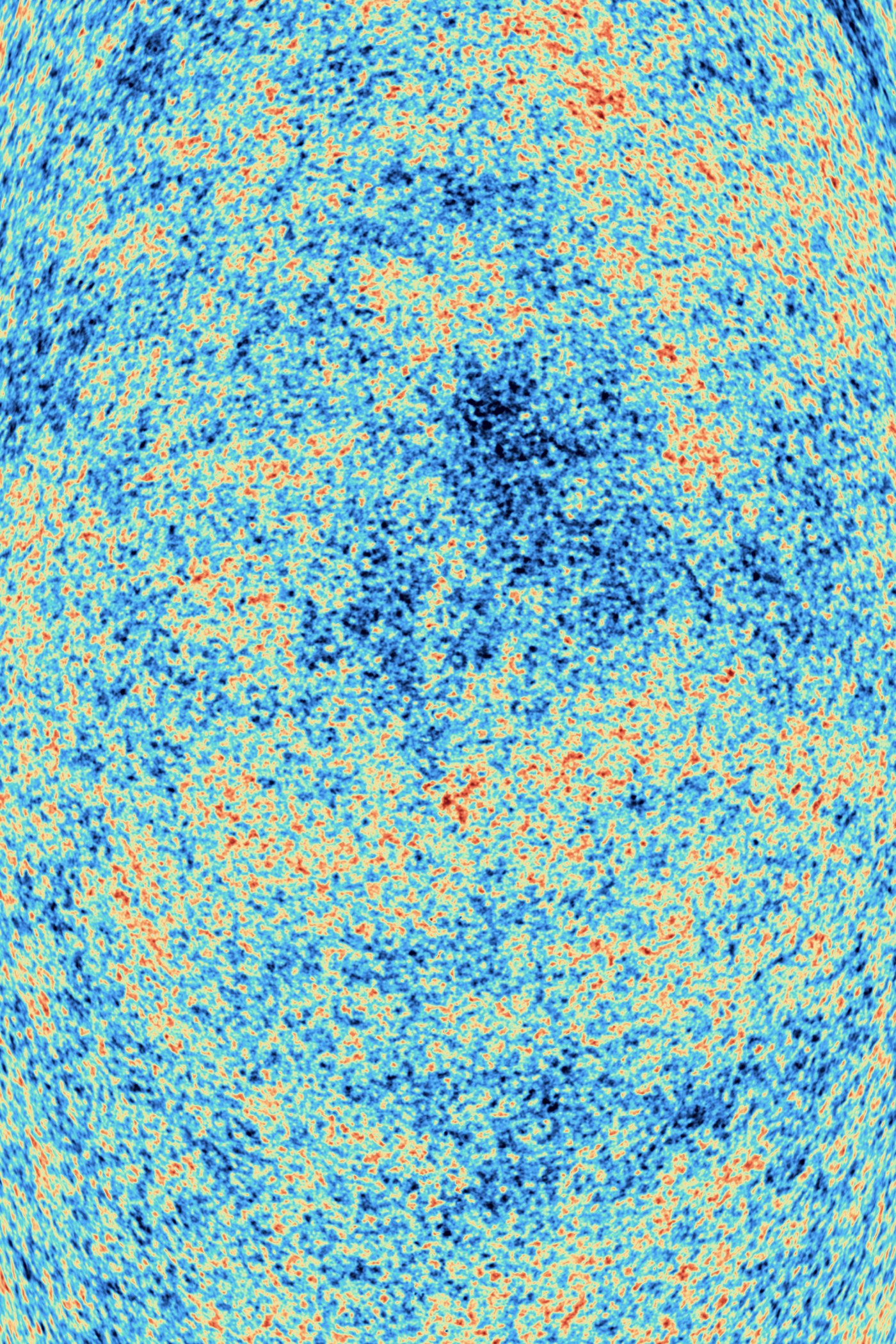 Part of the Planck 2018 map of the cosmic microwave background. The sizes and heights of the spots fix the baryon and dark matter densities to better than one percent. Image: Mark McCaughrean, from ESA Planck data; CC BY-SA 4.0; resized.
Now the important part. Each of those two numbers is measured several independent ways, and the ways agree.
For dark matter: the stars in the outer parts of spiral galaxies orbit at a nearly constant speed far past where the visible matter thins out, which Vera Rubin and Kent Ford measured through the 1970s. Newton’s law, solved for the mass, says the mass inside a radius must grow in proportion to that radius, out where there is little to see. Galaxy clusters hold together at speeds that would fling them apart if only the visible mass held them, which is what Fritz Zwicky noticed in 1933. Light from distant galaxies bends around clusters by amounts that map the mass directly, and the map does not follow the gas. The Bullet Cluster at the top of this page is the clearest case: two clusters collided, the hot gas, which is most of the ordinary matter, slowed and piled up in the middle, and the mass, mapped by lensing, kept going with the galaxies. And the microwave background’s spot pattern needs a component that feels gravity but not the pressure of light, in the amount above, or the pattern comes out wrong.
For dark energy: distant supernovae are fainter than a coasting universe allows, which is the 1998 result that won the 2011 Nobel Prize. The scale of the acoustic ripples frozen into the galaxy distribution, measured at many distances, tracks the expansion history and needs the same thing. The microwave background’s geometry, combined with the matter density, needs it too.
That is what “thoroughly tested” means in Peebles’s sentence. The effects are measured by different instruments, at different epochs, through different physics, and the cosmological ones are fitted, inside the standard model with a constant dark energy, by one pair of numbers. The fit is good rather than perfect: two measurements of the expansion rate disagree by about eight percent, the clumpiness of matter measured by lensing runs a little below what the microwave background predicts, and the newest expansion data, below, prefer a dark energy that changes with time. Those are strains on the standard fit, and they are the reason “tested” is not “finished.” Peebles’s “thoroughly tested” is a 2019 sentence; the strains are what testing looks like when it continues, and if the newest preference hardens, the effective description itself will change, not only the name. To be clear about which layer each strain touches: the expansion-rate and clumpiness tensions press on the effective model’s parameters, the new expansion data press on its assumption of a constant, and none of the three touches the measured effects themselves.
What is named
And here is what “mysterious” means. Not one of those measurements says what the extra mass is. Every one of them is a measurement of gravity, or of geometry, or of expansion: extra mass we cannot see, extra stretching we cannot explain. The name “dark matter” is a name for the mass measurements. The name “dark energy” is a name for the expansion measurements. Neither name is a thing. Physicists know this, and say it; Peebles’s Nobel interview is one of many places they have said it. Experiments have searched underground for the long-leading guess for dark matter, a heavy particle that interacts weakly, for nearly four decades without a detection. The leading guess for dark energy, a cosmological constant, is a number with no accepted account of its size.
A cosmologist would stop me here, and rightly. “Dark matter” in the working theory is more than a label on a residual. It is a specified component: non-baryonic, cold, collisionless, at a fixed cosmic density, and those properties do work. They set the height of the third acoustic peak in the microwave background, the growth of structure from the early universe to the galaxy web, and the acoustic scale the galaxy surveys measure, and each of those was a prediction before it was a measurement. So the effective description has positive content and has passed tests, and “placeholder” is fair only at one layer: what the stuff is. Nobody has a particle, and nobody has a mechanism for the constant. The viral post ran those layers together, and so does the phrase “neither name is a thing” if it is read too fast. The measurements are firm; the effective description is well tested; the identity is open. Three layers, and the placeholder is the third.
This site has a page about exactly this distinction, The Test Confirms the Effect, written for relativity’s tests. The same rule applies here word for word: a confirmed measurement can never, by itself, prove which mechanism produces it. The rotation curves are solid. The lensing is solid. The microwave background is solid. What they establish is an effect. What they cannot establish is a substance.
So the post’s readers who took “placeholder” to mean “made up” have it backwards, and the post’s phrasing invited them to. The measurements are made to better than one percent, and the effective description passes its tests. The names for what the stuff is are placeholders. All three things are true, and the third does not weaken the first two.
Where the picture is moving
Two developments are worth knowing about, because a reader of the post might think the field is standing still.
The first is on dark energy. The Dark Energy Spectroscopic Instrument published its second data release in March 2025, three years of observing, measuring the acoustic scale with more than fourteen million galaxies and quasars. Fitted with a dark energy whose strength is allowed to change with time, the data prefer a changing one over a constant: at 3.1 standard deviations combined with the microwave background alone, and between 2.8 and 4.2 when supernova samples are added, depending on which sample. The preferred fit has dark energy slightly weaker than a constant today and stronger in the past, crossing the constant’s value at a redshift near 0.4, whichever supernova sample is used. That is short of a discovery, and it is the strongest observational pressure the cosmological constant has faced since it was adopted, building on a first hint in the survey’s 2024 release; and it is exactly the kind of thing a mechanism, any mechanism, would have to explain if it is real.
The second is on the alternative to dark matter that has done the most work, Milgrom’s modified dynamics, which changes the law of gravity at very low accelerations instead of adding mass. It fits the rotation curves of individual galaxies with one universal constant plus each galaxy’s stellar mass-to-light ratio, and it predicted a relation between a galaxy’s visible mass and its rotation speed before that relation was measured well. Galaxy clusters are where it has always struggled, and the Bullet Cluster is a live dispute this year: on their abstracts’ own terms, one 2026 analysis, prompted by the Webb-based lens model, confirms the usual residual missing mass in the cluster as a whole, and a second, from the modified-dynamics side, re-estimates the baryonic masses from the Webb photometry and argues that once stellar remnants are counted the lensing in the three cluster cores is consistent with the theory. On the microwave background, the relativistic extension called AeST does reproduce the spot pattern; a common criticism, which I share, is that its extra field behaves like dark matter under another name. Its status is a real research programme with real successes at one scale and contested results at others, which is a fair summary of the alternatives this site has looked at.
What this project makes of it
This site’s founding argument is that physics describes what happens and stops short of saying what physically acts, and “dark matter” and “dark energy” are the two largest places in physics where that is so. The effective description above is real physics, and the argument is about the layer beneath it: what the cold, collisionless component is made of, and what sets the constant. The post’s complaint is this site’s complaint. So it matters to say what this project has actually done with the complaint, because the same rule that makes the names placeholders makes the medium one too, until it produces numbers.
 James Peebles at a conference in May 2010. Photo: Juan Diego Soler, via Wikimedia Commons, CC BY 2.0; resized.
On dark matter, this project has proposed two things. The first was that the pressure medium’s own mass density simply is the dark matter. This project retracted it on 6 August 2026, and the retraction sits on the article that proposed it: bounding the medium’s opacity from lunar laser ranging and its heat exchange from the Earth’s measured heat flow caps its density at a fraction of what the rotation curves and the microwave background require, short by a factor of five at least and by sixty on the most direct reading of the theory’s own conventions. The second, which predates the first and survives it, is a scale-dependent effective gravity that flattens rotation curves without extra mass. This project fitted it to the real SPARC rotation-curve sample, and the fit is poor: a reduced chi-squared near 82 against the 1 to 5 that modified dynamics and dark-matter halos achieve, and the first paper’s headline rotation-curve figure cannot be reproduced from the parameters that paper states, which the site’s own Reference Guide records as a corrigendum. The Gaps in Science page says all of this, and it says what “addressed” means there: a mechanism is proposed, and it does not yet fit the data.
On dark energy, this project’s Paper 9 attributes the acceleration to residual pressure in the medium at the largest scales. Bounding the medium’s momentum flux from the measured value of G and from lunar laser ranging puts its total energy density around 10⁴⁷ times what dark energy needs. So the residual has to be one part in 10⁴⁷ of the whole, which is the cosmological constant problem restated in this theory’s vocabulary and inherited rather than solved. Worse, the scaling law the residual was supposed to come from goes to zero at large scales, and evaluated at the Hubble length instead it lands between 57 and 160 orders of magnitude below the required density. That too is on the gaps page.
So this project’s record on the dark sector, stated the way the site’s own rule requires, is this: one proposal retracted by its own calculation, one proposal that fits the data badly, and one that inherits the standard model’s hardest problem and whose mechanism does not survive. That record is what a mechanism claim looks like when it is held to the measurements rather than to the argument, and it is the difference between this site’s version of “the names are placeholders” and the post’s. The post stops at the sentence. This site has to say what it put in the placeholder’s place, and what happened when it did.
Where this leaves it
What this project did: it traced the viral quote to the nearest thing Peebles actually said and quoted that; it separated the measurements, which are firm, and the effective description, which is tested, from the names, which are placeholders, and gave the reader the evidence for each; it noted the two places the picture is moving; and it stated its own record on both problems against its own pages, including a retraction and a failed fit.
Check, re-runnable by anyone: the script is at /models/a-name-is-not-a-thing-v1.py, and
python3 a-name-is-not-a-thing-v1.py --selftest
checks that the computed matter fraction lands inside Planck’s own error on it, that cold dark matter outweighs ordinary matter by the well-known factor of about five, that the rounded budget is the familiar 5, 26, 69, that a flat rotation curve doubles the enclosed mass when the radius doubles while a central mass gives a speed falling as the inverse square root, that the DESI fit crosses the constant’s value at a redshift of three sevenths, and that a cosmological constant has no crossing at all. Without the flag it prints each step with its inputs.
Exactly how: the budget is three published parameters and a division; the rotation-curve inference is Newton’s law solved for the enclosed mass; the crossing is one line of algebra on the survey’s quoted fit. None of it says what dark matter or dark energy is, and the script says so in its last line.
Compared against the standard: a standard review often cited for the history of dark matter’s evidence is Bertone and Hooper’s 2018 paper in Reviews of Modern Physics, and the reference for the parameters is Planck 2018. This site conforms to the mainstream position, which is also Peebles’s own, in treating the measurements as settled, the effective description as tested, and the identity as open. Where it does not conform is in having tried to fill the placeholder, and in reporting the failures on its own pages, which the standard account, being a survey of evidence rather than a mechanism, does not have to do.
| Claim | Status here | On what evidence |
|---|---|---|
| The universe holds about five times more non-baryonic matter than baryonic, and galaxies and clusters show mass discrepancies that grow with radius | Proven | The cosmic ratio from the microwave background; the discrepancies from rotation curves, cluster dynamics, gravitational lensing and the Bullet Cluster, all pointing the same way |
| The expansion is accelerating | Proven | Supernova distances (1998), acoustic-scale distances, the microwave background’s geometry |
| Dark matter is a particle; dark energy is a cosmological constant | Generally accepted but unproven | No particle detected in nearly four decades of direct searches; the constant’s value unexplained; DESI 2025 prefers a changing dark energy at 3 to 4 standard deviations |
| Modified dynamics replaces dark matter | Unproven systems at large | Fits galaxy rotation with one constant plus mass-to-light ratios; cluster residual mass disputed in 2026; the microwave background reproduced only by an extension whose extra field acts like dark matter |
| The pressure medium’s density is the dark matter | Disproven, retracted on its own page | This project’s own bound, 2026-08-06: at least five times too tenuous |
| This project’s scale-dependent gravity explains rotation curves | Fringe, does not yet fit the data | Reduced chi-squared about 82 on SPARC against 1 to 5 for the alternatives |
| The medium’s residual pressure is the dark energy | Fringe, mechanism does not survive | One part in 10⁴⁷ fine-tuning inherited; the scaling law’s large-scale limit is zero |
Notes on sources, and how firm each claim is
The post is x.com/NightSkyToday/status/2102641360750707115 (23 September 2026), a portrait of Peebles and a stock image of a cosmic web; it links no source. Peebles’s 2019 words: the AFP report of the Nobel telephone interview, 8 October 2019, as carried by Phys.org, read; the “mysterious” sentence is quoted verbatim and “open question” is the report’s own summary, marked as such in the body; a CBC Radio interview from the same week is quoted in search summaries as “we don’t know what it is … a deep mystery,” but I could not reach the page and do not quote it in the body. The 2020 lines: New Scientist, as quoted by Futurism on 3 June 2020, read there, not at source. The 2023 essay: “In defence of dark energy,” Institute of Art and Ideas, 2 March 2023; its opening is readable on the page, the rest sits behind a paywall in the rendered view but is present in the page’s served source, and the two sentences quoted from it in the body of this article (the 1982 “more comfortable fit” line and the 1984 “continue to fit the growing evidence” line), and the 1990s and 2000 remarks, were checked against that source text word for word by a reviewer, and also against a reader’s comment on the page quoting them. Planck 2018: arXiv:1807.06209, abstract read; the fractions computed here from its Ω_b h², Ω_c h² and H₀, with the flat closure and no neutrino term, which is why the dark-energy figure reads 68.7 where Planck’s own is 68.5. DESI DR2: arXiv:2503.14738, Physical Review D 112, 083515 (2025), abstract read for the significances; the w₀ and w_a values in the script are the rounded figures for the combination with the Union3 supernova sample, from the collaboration’s public summaries, not the paper’s table; the other combinations put the crossing between redshift 0.39 and 0.50. The Bullet Cluster dispute: Famaey, arXiv:2605.10022 (May 2026), and Zhang, Haghi, Asencio, Banik, Kroupa and colleagues, arXiv:2606.19454 (June 2026), both from their abstracts; AeST: Skordis and Złośnik, Physical Review Letters 127, 161302 (2021), from its citation record. Peebles’s own papers: Astrophysical Journal Letters 263, L1 (1982) for cold dark matter and Astrophysical Journal 284, 439 (1984) for the return of the constant, cited from their citation record. Rubin and Ford, Zwicky, the 1998 supernova result, and the direct-detection null: standard history, stated at textbook level. Bertone and Hooper, Reviews of Modern Physics 90, 045002 (2018): a standard review, named from its citation record, not re-read. This project’s own record: the Gaps in Science page, the retraction on Dark Matter Isn’t Missing, and the 2026-08-06 findings register in the project’s working notes, quoted as they stand. Firmest: the Planck budget, the evidence list, and this project’s own retraction. Least firm: the exact DESI best-fit values, which move between data combinations and are used here only to show the shape of the fit.