A Field Guide to Logical Fallacies (And Why This Project Needed One)
September 2026

This site runs on one promise: don’t claim more than the evidence supports. The Test Confirms the Effect made that promise concrete, and while it was being written, an earlier draft broke it. That draft cited GPS, LIGO, and the Event Horizon Telescope together as blanket proof of a mechanism, exactly the reasoning error the finished article is about: a confirmed measurement proves an effect happened, not which explanation caused it. It was caught in the same conversation and fixed before publication.
That’s not a hypothetical. It’s a dated, real instance of the thing this page exists to prevent: a reasoning error caught before it ships, in a project that specifically tries to catch them.
What a logical fallacy actually is
A fallacy isn’t just “an argument I disagree with.” It’s a pattern of reasoning that looks persuasive but doesn’t actually establish what it claims to. Some are formal, a broken logical structure. Most of the ones below are informal: the structure is fine, but the argument smuggles in an unearned assumption, a loaded comparison, or a conclusion that doesn’t follow from the evidence given. They’re worth knowing by name because a named pattern is easier to catch in your own writing than an unnamed feeling that something’s off.
Two resources, two purposes
The full archive: Owen M. Williamson, a lecturer at the University of Texas at El Paso, compiled a genuinely thorough list of 146 named fallacies for a UTEP composition course (hosted under ENGL 1311; its own cover page titles it a UNIV 1301 University Seminar handout), and dedicated the whole thing to the public domain, explicitly inviting anyone to copy, mirror, and update it. It’s a real, citable reference: the original PDF is hosted here, full credit to its author.
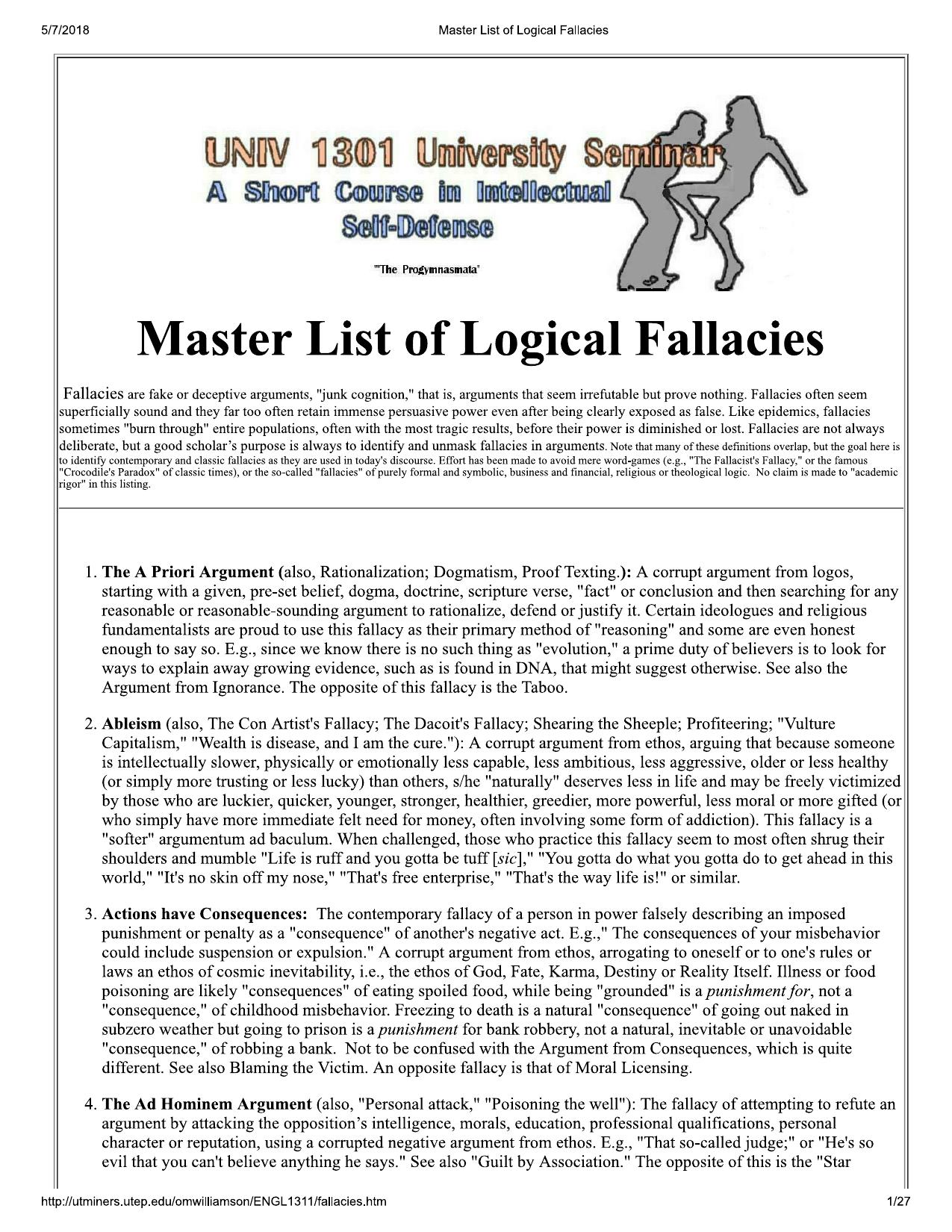 The source document’s own title page. Owen M. Williamson, UTEP ENGL 1311, dedicated to the public domain.
The list below: a working subset, picked for what actually shows up in technical arguments like the ones on this site, not the ones most common in political rhetoric. Examples are current and specific to the kind of reasoning this project has to check constantly: does a measurement really prove what it’s being cited to prove?
The working list
| Fallacy | What it looks like | Why it matters for a project like this one |
|---|---|---|
| Confirmation Bias | Noticing the evidence that fits what you already believed, and stopping there. | The single easiest way to end up “confirming” a theory that was never actually tested against a case where it could fail. |
| The A Priori Argument | Starting from the conclusion you want and searching for arguments to justify it, instead of reasoning toward it. | This is how a model gets built to reproduce a known answer and then gets presented as if it predicted that answer independently. |
| Argument from Ignorance / Shifting the Burden of Proof | “Nobody’s disproven it, so it must be true,” or demanding a critic disprove a claim instead of proving it yourself. | The whole point of underdetermination (see The Test Confirms the Effect) is that a theory surviving every test so far is not the same as a theory being proven. |
| The Post Hoc Argument | B happened after A, so A must have caused B. | A test result changes right after a new instrument or method is introduced; it’s tempting to credit whatever theory was being tested for the improvement, when the instrument change itself may be the actual cause. |
| Either-Or Reasoning | Presenting only two options when a third, or a middle ground, actually exists. | “Either this is established physics or it’s crackpot nonsense” skips the real, clearly labeled middle category this site uses: fringe, untested, worth checking. |
| Overgeneralization | Applying a broad rule to a specific case that actually needed its own look. | A test passing in one regime (say, weak gravitational fields) doesn’t mean a theory is validated in every regime. |
| The False Analogy | Comparing two things that are only superficially alike. | Physics is full of these; the trick is checking whether the comparison holds at the level that actually matters, not just the level that sounds good. |
| The Straw Man | Responding to a weaker, easier-to-refute version of an argument instead of the real one. | Easy to do by accident when summarizing a rival theory before critiquing it. Worth re-reading the original before knocking it down. |
| Star Power / Faulty Use of Authority | Trusting a claim because someone credentialed said it, without checking the actual argument. | A Nobel Prize backs up that gravitational waves were detected; it doesn’t automatically back up every claim made about what that detection means. |
| The Bandwagon Fallacy | Treating wide agreement as proof. | Consensus is real evidence of a theory’s track record, not a substitute for checking the evidence yourself. |
| Sunk Cost (Throwing Good Money After Bad) | Continuing to defend a model because of how much work already went into it, not because it’s still the best-supported option. | The measurement audit exists precisely because this project’s own gravitational-wave mechanism failed a real test against LIGO’s polarization data. The right response was to say so plainly, not to keep defending the mechanism. |
| Availability Bias | Over-weighting whatever example is most immediately at hand. | The most recent headline result isn’t automatically the most representative one; older, quieter results still count. |
| Moving the Goalposts | Raising the bar for evidence again, right after it’s been met. | A theory that keeps getting “one more test” added whenever it clears the last one isn’t being tested fairly. |
| The Half Truth | Technically accurate, but missing context that would change the picture. | Citing a net result (like GPS’s +38 microseconds/day) without noting that part of it is a theoretical decomposition, not an independent measurement. |
| Circular Reasoning | The justification for A secretly already assumes A. | Closely related to the A Priori Argument above; Williamson’s own source list notes many of these definitions genuinely overlap. Here the tell is a claim whose “confirmation” only holds because the confirming step already assumed the claim. |
| The Plain Truth Fallacy | Favoring the simplest explanation because it’s comfortable, not because it’s actually the best-supported one. | Simplicity is a real virtue in a theory; it’s not a substitute for a theory actually fitting the data. |
| The Paralysis of Analysis | “We can never be 100% certain” used as a reason to never draw any conclusion. | Underdetermination means a mechanism isn’t proven beyond all rival explanations; it doesn’t mean nothing can ever be said. |
| Defensiveness (Choice-Support Bias) | Reflexively defending a past conclusion once it starts looking shaky. | The right move when your own model fails a test is retraction, in writing, not a quieter defense of the original claim. |
| The Slippery Slope | Assuming one step inevitably cascades to an extreme outcome, with no real mechanism connecting the steps. | “If we allow one untested mechanism, we have to accept every untested mechanism” isn’t an argument; it skips the actual evaluation. |
| The Argument from Incredulity | Rejecting a claim just because it sounds strange. | Cuts both ways: dismissing a fringe idea because it sounds odd, or dismissing a mainstream result because it sounds odd, are the same error. |
| The Two-Sides Fallacy (False Balance) | Presenting something as a genuine even debate when the evidence actually favors one side clearly. | Quantum entanglement and Bell’s theorem are a real wall, not an open debate; treating it as 50/50 misrepresents the actual state of the evidence. |
| The Red Herring | Introducing something true but irrelevant that pulls attention from the actual question. | An interesting side fact isn’t a substitute for addressing the specific objection that was raised. |
| The Non Sequitur | The stated conclusion doesn’t actually follow from the reasoning given. | Watch for “this matches, therefore the mechanism is confirmed” when the argument only established that the numbers matched. |
| Lying with Statistics | Using a true number to imply something the number doesn’t actually establish. | A percentage or a fit quality can be technically correct and still misleading without the comparison that gives it meaning. |
| The Snow Job | Burying a claim in true but hard-to-evaluate data so the audience can’t properly check it. | A wall of equations isn’t automatically evidence a claim is correct; it can also be a wall nobody has time to actually verify. |
What this page changes about how this project works
The corrective action isn’t new: this site already runs a formal audit before treating any test as proof of a mechanism, laid out in full in The Test Confirms the Effect, and that audit already covers eight named relativity tests. What’s new here is naming and formalizing the broader discipline that audit is one instance of. From here forward, a new argument, claim, or plan going through the Article & Content Publishing Checklist gets checked against the working list above too, the same underlying discipline the measurement audit table already applies to relativity claims specifically.
One real catch: the underdetermination case described at the top of this page. An earlier draft of the flagship article on this exact subject overclaimed in exactly the way this page is meant to prevent, and the catch happened before publication, not after a reader found it. One instance doesn’t prove this list catches everything going forward; it’s the reason the list exists in the first place.
Compared against known best practice: this page adopts, rather than invents, an established standard. Owen M. Williamson’s list is a real, citable work built for exactly this purpose, teaching students to recognize informal fallacies in real arguments. Where this page differs from a straight copy: it’s curated down to the roughly two dozen most relevant to technical, evidence-based argument rather than general rhetoric, and the examples are drawn from this project’s own real work rather than politics or advertising. That’s a narrower, more specific tool built on top of a broader, well-established one, not a replacement for it.
A test confirming a real effect proves the effect happened. A fallacy caught before it ships proves the argument was checked, not just believed.