The Test Confirms the Effect. It Doesn't Prove the Explanation.
September 2026
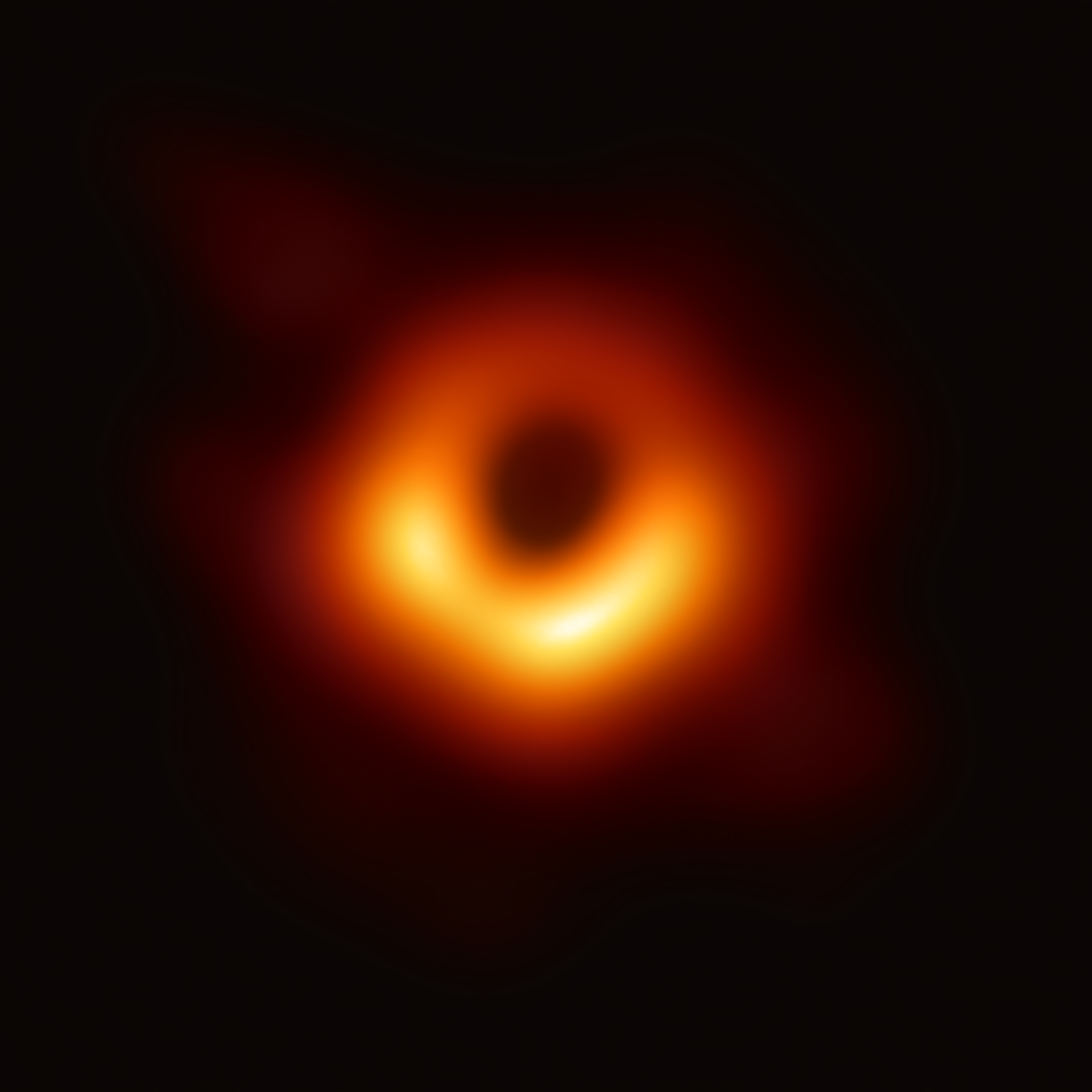 Photo: Event Horizon Telescope / ESO, via Wikimedia Commons, CC BY 4.0.
GPS works. LIGO detected gravitational waves matching Einstein’s predictions almost perfectly. The Event Horizon Telescope photographed a black hole’s shadow at exactly the size General Relativity says it should be. Put together, these get cited as closing the case: relativity is confirmed, spacetime curvature is real, the question is settled.
Two of those three claims are exactly right. The third slips in something the data never said.
The distinction
A measurement can confirm that an effect is real without proving which mechanism causes it. This has a name in philosophy of science: underdetermination of theory by evidence, from the Duhem-Quine thesis. A set of correct predictions can come from more than one underlying mechanism. Passing the test only confirms the prediction, not that one specific explanation is the only one that could produce it.
This isn’t a fringe objection. It’s acknowledged in the mainstream physics literature, and there’s a whole framework built to handle it: the Robertson (1949) / Mansouri-Sexl (1977) test theory, designed specifically to compare rival theories against the measurements that could distinguish them. The concrete case in hand: Lorentz Ether Theory (absolute time, physical effects on matter moving through a medium, no curved spacetime at all) makes identical predictions to Special Relativity everywhere both have ever been tested.
That equivalence is established, and it’s specifically about Special Relativity. Extending the same idea to gravity, matching General Relativity’s own domain, is a separate and much harder project, sometimes called General Lorentz Ether Theory in the literature, and it doesn’t have the same settled track record. This project is attempting its own version of that extension. Here’s how it’s going: partly matching, partly not.
GPS
GPS satellites run fast clocks that need a correction of +38 microseconds per day, or the system drifts into uselessness within minutes. That number is solid: measured, continuously reconfirmed by the system working at all.
Here’s the part that gets skipped. That +38 microseconds is usually explained as two pieces added together: about −7 microseconds from the satellite’s orbital speed (special relativity’s velocity term), and about +45 microseconds from being higher in Earth’s gravity well (general relativity’s gravity term). Those two numbers were never separately measured. They’re two formulas, computed separately and added: a theoretical decomposition, not two independent readings off two instruments.
That distinction matters because this project’s own gravity extension, absolute time plus physical effects from a medium, reproduces the same net number using its own version of the same math. A working model built from that starting point lands at +38.45 μs/day, closely matching GPS’s real net correction (commonly cited as approximately +38 to +39 μs/day, depending on rounding). GPS needing a relativistic-style correction is proven. Which specific mechanism produces that correction is not settled by GPS alone.
Not every test has this hole
The same audit doesn’t find a hole everywhere. Modern Ives-Stilwell experiments (Saathoff 2003, Botermann 2014) measure velocity and time dilation jointly, from simultaneous forward-and-backward Doppler shifts, specifically built to avoid the GPS-style decomposition problem. Pound-Rebka and modern optical-clock height tests compare clocks at essentially zero relative velocity and vary only height: a plain ruler measurement, no theory-laden splitting required. Both come back clean. The lesson is narrower: check each test on its own terms.
Where the hole closes for good
LIGO and the Event Horizon Telescope sit on the other end of this spectrum, and deserve the same scrutiny in the opposite direction. GPS supplies one net number that more than one mechanism can hit. LIGO supplies something far richer: a specific waveform shape, a polarization signature (Takeda, Morisaki & Nishizawa, 2021), and a wave speed matched to light’s own speed to one part in a thousand trillion. That’s measured directly, from a gravitational wave and a gamma-ray burst from the same cosmic event arriving about 1.7 seconds apart after a 130-million-year trip. A rival mechanism has to match all of that at once, not just one aggregate total.
We know this isn’t just a theoretical hurdle, because we tried to clear it ourselves. This project’s own attempt at a mechanical account of gravitational waves ran directly into LIGO’s polarization data and failed. The candidate medium could only produce one wave type, and the real measurement requires a different one. This rival mechanism made a checkable prediction, and it was wrong.
What this project does about it
The corrective action: every relativity test cited in this project’s own work gets checked for one specific thing before it’s used as evidence for anything. Is the reported number a net result, or does it hide an unmeasured theoretical split? That check is called the measurement audit, and it’s a standing table, not an assertion. Split means the reported number hides an unmeasured theoretical decomposition, GPS’s own problem above. None means no such split exists:
| Test | Popularly cited to prove | What it actually, solidly shows | The real gap, if any |
|---|---|---|---|
| Michelson-Morley | Relativity itself | A real, solid null result: no ether-wind effect on light speed. | None. This project’s own model relies on this result as a starting point. |
| Muon/pion decay (storage-ring tests) | Time dilation, full stop | The decay-rate change with speed is real and measured. | Split, narrowly: the comparison depends on one unverified calibration step, not an independent kinematic fact. |
| GPS | Relativity, therefore spacetime | The net +38 μs/day correction is real, solid, and continuously reconfirmed by the system working. | Split: the −7/+45 μs/day breakdown is theoretical, never independently measured. The net number itself is solid. |
| Hafele-Keating (flying atomic clocks) | Same as GPS | Same structure: the net eastward/westward shifts are real and measured. | Split, same as GPS: the causal breakdown is theoretical, not independently measured. |
| Modern Ives-Stilwell | Time dilation | Extracts velocity and dilation jointly from simultaneous forward/backward Doppler shifts, built to avoid the GPS-style split. | None. Nothing here is decomposed into unmeasured pieces. |
| Pound-Rebka / optical-clock height tests | Gravitational time dilation | Height is a classical ruler measurement, no theoretical splitting required. | None found. |
| LIGO (GW170817 polarization and speed) | Relativity itself, decisively | A specific waveform shape, a polarization signature, and a speed matched to light to one part in a thousand trillion, all measured directly, with nothing split or decomposed. | None. Harder to fake than GPS: this project’s own rival mechanism was tested against it directly and failed. |
| Event Horizon Telescope (black hole shadow imaging) | Relativity itself | The shadow’s size matches General Relativity’s predicted geometry for the mass involved. | None, but weaker than LIGO’s entry: no rival mechanism has actually been tested against this data yet. |
One instance, caught in real time: an earlier draft of this article made precisely the error it describes, citing GPS, LIGO, and black-hole imaging together as blanket proof of a mechanism, with no audit applied. It was caught in the same conversation and corrected before publication. One instance doesn’t prove this catches every case. It does show the mistake is easy to make even inside the project built specifically to avoid it. That’s partly why this piece exists, and why that catch is now one worked example in A Field Guide to Logical Fallacies, a broader reference for the reasoning errors this project checks against before publishing anything.
Compared against the documented standard: the Robertson/Mansouri-Sexl framework exists precisely to separate “theories agree on the numbers” from “theories agree on the mechanism,” and this project’s measurement audit is a plain-language version of that same discipline. Where we fall short of the full academic framework: we haven’t built its formal parameterized version, only its underlying distinction. That’s a gap.
One boundary, so this reasoning doesn’t get stretched further than it holds: quantum entanglement is a different animal. Bell’s theorem doesn’t leave room for a hidden local mechanism the way these tests do. It experimentally rules one out. That’s a genuine wall, confirmed by experiments (Aspect, Clauser, and Zeilinger, Nobel Prize 2022), not an open question this same argument can answer.
A test that confirms a real effect proves the effect happened. It doesn’t automatically prove which mechanism caused it.