Two, Eight, Eight, Eighteen: The Pattern the Spiral Is Trying to Show
23 September 2026
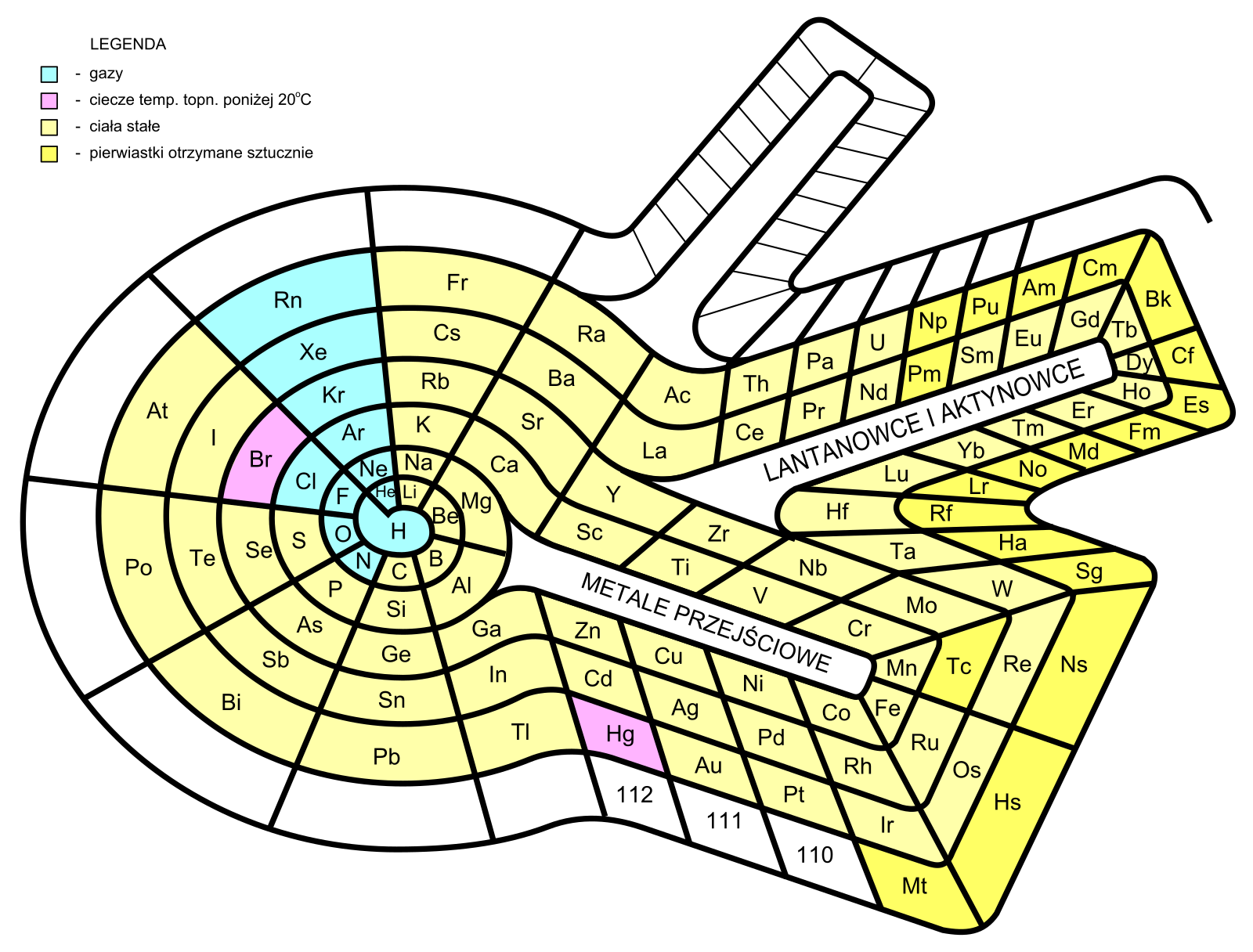 Theodor Benfey’s spiral periodic table, devised in 1960 and printed in Chemistry magazine in January 1970, in the Polish-labelled vector version on Wikimedia Commons (Bastianow, after a 2005 graphic by J. Scholten; CC BY-SA 4.0; rasterised, otherwise unaltered). The legend reads gases, liquids below 20 °C, solids, and artificially made elements; the two peninsulas are the transition metals and the lanthanides and actinides. This vector is itself dated: it carries “Ha” for element 105 and “Ns” for 107, names replaced by dubnium and bohrium in 1997, and leaves 110 to 112 as numbers. The structure is what it is here for.
A post from the Cosmos Archive account went round this week with four short paragraphs on the periodic table and a picture of a “3D Periodic Table,” a coloured spiral with the elements laid out in rings. The text is fine. It says, in its own words, that the table “is really a map of repeating chemical behavior,” that Mendeleev ordered the elements by atomic weight and saw their properties repeat, that the modern table orders them by atomic number instead, and that the important part is the repeating pattern, not the shape of the chart. All of that is right.
The picture fails. I will say briefly what is wrong with it, because this site has a rule about not amplifying a diagram it would then have to correct, and then spend the rest of the piece on what the picture was trying to show, which is worth the attention: the pattern itself, where each part of it comes from, and what this project’s own model of the atom has and has not done about it.
What the graphic gets wrong
The image is watermarked with the account’s own handle and matches none of the three real alternative designs named below. Four checks anyone can make from the image alone:
- The legend puts hydrogen and helium in “periods 1 to 2” and calls periods 5 and 6 “transition metals and post-transition elements.” Helium is period 1. The transition metals begin in period 4, with scandium.
- Several elements appear twice. Scandium, vanadium and americium each have two cells. Neighbours are scrambled: nickel sits beside potassium, bromine beside argon.
- Four cells carry the placeholder names Uun, Uuq and Uuo, Uun twice. Those were the temporary labels for elements 110, 114 and 118 before they were named darmstadtium, flerovium and oganesson, in 2003, 2012 and 2016.
- The colour bands do not follow the period structure the legend assigns them.
Real spiral tables exist, and they are correct. Benfey’s, above, winds outward from hydrogen with the transition metals and the f-block pulled out as peninsulas. Charles Janet’s left-step table of 1928 arranges the same information as a staircase. The Alexander Arrangement of 1965 is a genuinely three-dimensional strip, folded so that each period connects to the next without a break. Any of them would have served the post’s point. The picture, which reads as generated, does not, and it is a small example of something this site keeps meeting: a diagram with the look of knowledge and none of the content.
The pattern
Here is the pattern, stated plainly. Count the elements in each row of the standard table. The rows end at the last column, group 18: helium, neon, argon, krypton, xenon, radon, oganesson, with atomic numbers 2, 10, 18, 36, 54, 86 and 118. (The first six are the noble gases; oganesson is expected to be nothing of the kind, and I use the column, not the name.) Counting from zero, the elements between one closing number and the next are the period lengths:
2, 8, 8, 18, 18, 32, 32.
That sequence is the arithmetic skeleton of periodicity. The rest, the group resemblances and the trends across a row, hangs on it. Chemical behaviour repeats because the electron configuration repeats, and it repeats at those intervals. Mendeleev did not have the sequence in this form. He had atomic weights and chemical similarities, and in 1869 he arranged the known elements so that similar ones fell in the same column, leaving gaps where the pattern demanded an element nobody had found.
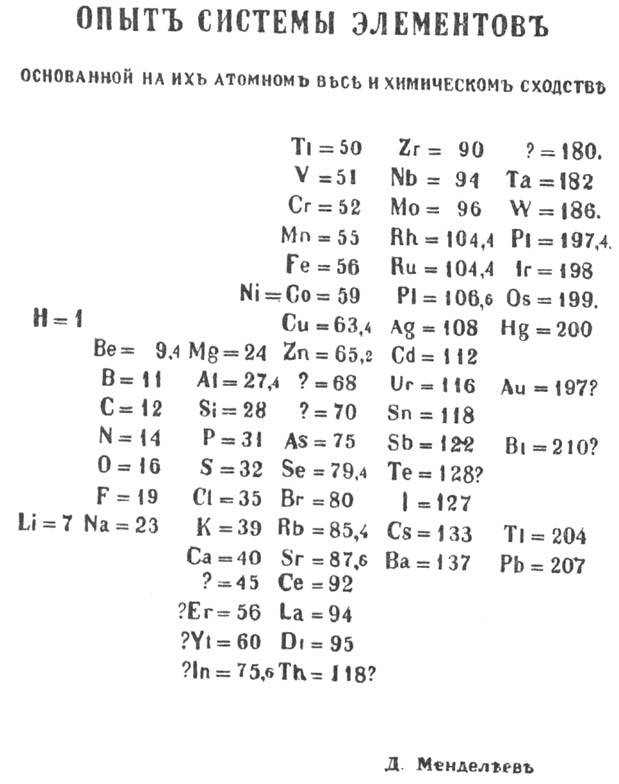 Mendeleev’s 1869 table, first edition. The gaps marked with question marks were predictions; gallium, scandium and germanium filled three of them within seventeen years. Public domain.
Gallium filled one of those gaps in 1875, scandium another in 1879, and germanium a third in 1886, each with properties close to what he had written down for it. That is the test that made the table more than bookkeeping. The reordering by atomic number came in 1913, from Moseley’s X-ray measurements, and it resolved the few places where atomic weight put elements in the wrong order.
Where each factor comes from
The sequence has three ingredients, and it helps to keep them apart, because they come from different places.
Angular patterns, from geometry. A wave confined around a centre of spherical symmetry can take only certain angular shapes, the spherical harmonics, and for each value of the angular quantum number $l$ there are $2l+1$ of them. One for $l = 0$, three for $l = 1$, five for $l = 2$, seven for $l = 3$: the s, p, d and f subshells. This is geometry. Any standing wave on a sphere has it, in an atom or in the free oscillations of the Earth and the Sun.
Two per pattern, from spin. Each angular pattern holds two electrons and no more, because electrons have spin one-half and obey Pauli’s exclusion principle. So a subshell holds $2(2l+1)$: two, six, ten or fourteen electrons.
The filling order, from the potential. This is where the doubling in the sequence comes from, and it is the ingredient the other two do not supply. In a hydrogen atom, in the non-relativistic model, every subshell with the same $n$ has the same energy, so if atoms filled shell by shell the periods would run 2, 8, 18, 32, 50. They do not. In an atom with many electrons the inner ones screen the nucleus, and the energy of a subshell depends on $l$ as well as $n$; in the neutral atoms as one walks up the table, 4s is occupied before 3d, 5s before 4d, 6s before 4f and 5d. The empirical summary of that filling sequence is Madelung’s rule: fill in order of $n + l$, and where two subshells tie, the lower $n$ first. Walk that order, start a new period at each new s subshell, and the counts come out 2, 8, 8, 18, 18, 32, 32, with the noble gases landing on 2, 10, 18, 36, 54, 86 and 118.
The rule is empirical. About twenty elements have ground-state configurations that depart from it by one or two electrons, chromium and copper the best known, palladium and thorium the two-electron cases; the count depends on convention. Two cautions travel with it. First, it is a summary of which subshells are occupied in the neutral atoms, and reading it as an energy ordering is a known error: in the transition metals themselves 3d lies below 4s, which is the point of Schwarz and Rich’s much-cited 2010 review in the Journal of Chemical Education and its companion paper, cited here from their citation record rather than re-read. Second, the configurations themselves are computed from the Schrödinger equation for many-electron atoms as a matter of routine; what has no closed-form derivation is the $n + l$ mnemonic. None of the exceptions moves a period boundary, because each shifts electrons within a period, so the lengths are safe even where the rule is not exact. What matters here is where the rule comes from: the radial part of the problem, how the potential an outer electron sees is shaped by the electrons inside it. That decision belongs to the potential alone.
What this project makes of it
This site’s picture of the atom is an equilibrium shell: a nucleus emitting pressure outward into a medium that pushes back, and an electron as a standing wave where the two balance. The project’s own operating notes for the medium already say what that picture gets for free and what it does not. Angular structure, the s, p, d, f shapes and their 1, 3, 5, 7 degeneracies, is “close to guaranteed by spherical geometry alone.” That is the first ingredient above, and it is the same property geometry hands the Schrödinger equation. It is a necessary property of any spherically symmetric standing-wave model and evidence for none of them.
The second ingredient, two electrons per pattern, is spin and exclusion, and this project has no account of either; it takes them from the standard physics, as it takes the measured 2-8-8-18-18-32-32 as the target.
The third is where the work remains. The filling order is a statement about the radial potential inside a many-electron atom. A pressure model of the shell would have to produce that potential, or something that acts like it, and then reproduce the observed sequence: 4s occupied before 3d at potassium and calcium, 6s before 4f, and the interleaving that follows. The radial side has been attempted twice, and neither attempt stands. The same operating note that grants the angular part records an attempt to match the Bohr radius with a standing-wave condition; it needed a medium wave speed of about 250,000 times the speed of light; the program later falsified the use of that speed as the atom’s own clock speed and moved the atom onto a second medium at light’s speed, so the attempt no longer stands. And an order-of-magnitude count from August estimated how many radial standing-wave modes fit inside an atom’s transition band at between ten and forty, against the roughly nineteen subshells the heaviest atoms fill. The notes that record that count carry their own warning, that its index has no established mapping to $n$ or $l$ and that it is a bracket and not a match. The interaction range behind the ten-to-forty came from a separate heating requirement, and a later entry the same day chose the range that gives twenty against the nineteen subshells, which is a number aimed at its target. I repeat the warning here. An earlier article on this site proposed that the pressure parameter calibrated on nuclear binding should also track atomic radii across the table; Paper 13 examined that and says it is not yet a well-posed test.
There is a sharper objection than “the radial work is not done,” and it should be stated here rather than left for a reader to raise. The second ingredient, two electrons per pattern and no more, is the Pauli exclusion principle, and the period closures exist because of it. A standing-wave shell in a pressure medium, as this site has described it, contains no statement of exclusion: nothing in it says why a third electron cannot share a pattern, or why a shell closes. Quantum mechanics does not assemble the period lengths from three separate parts either; the filling order it computes is what antisymmetric many-electron states do in a Coulomb field, with exclusion built into the mathematics as a postulate of the non-relativistic theory. This project’s own notes already recorded that a classical circulation direction supplies no such statistics, so the objection is not new here. So the gap in this project’s model may not be a missing radial calculation. It may be a missing kind of physics, and a model that supplies the angular patterns and then borrows exclusion and the filling order from quantum mechanics has explained the periodic table exactly as far as geometry goes and no further. I do not know whether a medium model can produce exclusion-like occupancy without importing it. Until someone shows that it can, the status is “open, path not specified,” and nothing stronger; a reader who prefers “wrong category of theory until shown otherwise” is reading the same facts, and I will not argue with them.
So the status of this question is simple to state. The periodic table’s period lengths are a benchmark any model of the atom has to reproduce, in the order the real table records. Many-electron quantum mechanics reproduces them by computation, and summarises them with a rule that has no closed-form derivation. This project’s shell model inherits the angular half from geometry, borrows exclusion, and has not produced the filling order, and it has not yet said how it could. That is an open problem, named as one, and the right place to put it is on the Open Problems page rather than in a claim.
Where this leaves it
What this project did: it declined to republish the graphic and said why; it wrote down the pattern the graphic was trying to show, with the atomic numbers that define it; it separated the three ingredients of that pattern by where each comes from; it stated, against its own notes, which of the three its model has and which it has not; and it named the objection that the missing part may be a kind of physics the model does not contain.
Check, re-runnable by anyone: the script is at /models/two-eight-eight-eighteen-v1.py, and
python3 two-eight-eight-eighteen-v1.py --selftest
checks the four angular degeneracies and subshell capacities, the first nineteen subshells of the Madelung order, the seven period lengths, the seven noble-gas atomic numbers they add up to, the hydrogen-like $2n^2$ capacities for contrast, and two failure paths: filling by $n$ alone and a wrong tie-break both give the wrong lengths, so the rule is doing real work and the test can fail. Without the flag it prints every step.
Exactly how: one function returns $2l+1$; one multiplies by two; one sorts the subshells by $(n + l, n)$; one walks that order and cuts a period at each new s subshell. Two things in the script come from the real world: Madelung’s rule, which is an empirical summary of the real filling sequence, and the group-18 atomic numbers, which the script uses as the check. The script shows that the rule, walked correctly with the geometric capacities, gives the known lengths; it does not derive the lengths independently of the table, and nothing here claims it does.
Compared against the standard: the Aufbau principle with Madelung’s rule is the textbook account, and the many-electron calculation behind it is the actual standard; Schwarz and Rich’s 2010 review is the widely cited statement of what the rule does and does not mean. This site conforms in reproducing the period lengths from the same three ingredients, and in stating that the rule is an empirical summary with known exceptions. Where this site does not conform is that its own model of the atom has produced neither the configurations nor a rule for them, which the standard account does supply, by computation and by mnemonic respectively. The table below uses the classification of this site’s catalog pages.
| Claim | Status here | On what evidence |
|---|---|---|
| Chemical properties repeat with period 2, 8, 8, 18, 18, 32, 32 | Proven | The chemistry and spectroscopy of every group; group-18 atomic numbers 2, 10, 18, 36, 54, 86, 118 |
| Angular degeneracies 1, 3, 5, 7 follow from spherical symmetry | Proven | Spherical harmonics; shared by every spherical wave model |
| Ground-state configurations follow from many-electron quantum mechanics | Proven | Computed routinely and matched to spectroscopy, exceptions included |
| Madelung’s $n + l$ rule as a closed-form summary of the filling order | Generally accepted but unproven | Reproduces all seven period lengths; about twenty ground-state exceptions; no first-principles derivation of the rule itself |
| This project’s equilibrium-shell atom reproduces the period lengths | Unknowns, path not specified | Angular degeneracies inherited from geometry; exclusion borrowed, not derived, and without a mechanism of its own the model is not yet a candidate account of period closures; filling order not derived; the one radial scale attempted needed a wave speed the program no longer uses for the atom; the radial mode count is an order-of-magnitude bracket only |
Notes on sources, and how firm each claim is
The post is x.com/cosmosarcive/status/2102675334487589082 (23 September 2026); I read the image at full resolution and the four defects listed are visible in it; I quote the post’s text from the post itself, read via the API. Placeholder-name retirements: IUPAC’s systematic-element-name table, read via Wikipedia’s transcription of it, gives darmstadtium 2003, flerovium 2012, oganesson 2016. Benfey’s spiral: devised in 1960 (the Commons file description) and printed on page 27 of the January 1970 Chemistry (the Science History Institute’s catalogue record); the 1964 date given in some secondary accounts is not in either source and is not used here. Janet’s left-step table (1928) and the Alexander Arrangement (1965): from secondary accounts of the history of table designs; neither is reproduced here. Mendeleev 1869 and the gallium and germanium confirmations, and Moseley 1913: standard history, stated at the level of any chemistry text and not researched further for this piece. Madelung’s rule and its status: Schwarz and Rich, Journal of Chemical Education 87, 435 (2010), and Schwarz, same journal, 87, 444 (2010), both paywalled and known here from their citation record and from the Aufbau literature that cites them, not re-read for this article. The exception count of about twenty is the list on Wikipedia’s Aufbau page (eleven d-block, nine f-block); the two-electron cases are palladium and thorium. The mode-count bracket and its warning, the medium operating notes’ point 5, and the atomic-radii prerequisite are this project’s own records, quoted as they stand. Firmest: the period lengths and the arithmetic. Least firm: the exact exception count, which depends on convention and is cited, not recomputed; and the two Schwarz papers, characterised from their citation record. The earlier article’s atomic-radii claim still stands on that page uncorrected as of this writing; correcting it is a separate change to that page.