What Rounds a Planet: Pressure Does the Work, Gravity Sets the Target
6 August 2026
This site has said in several places that gravity is not a pull. That claim is ordinary physics rather than this site’s own theory — general relativity has described gravity as geometry since 1915, and an earlier article here works through what that means for a person sitting in a chair.
But it leaves a question sitting there. If nothing pulls, what makes a planet round?
The full answer has two halves, and most short versions of it — including the first draft of this article — collapse them into one. Pressure does the mechanical work of erasing bumps. Gravity decides what shape the bumps are being erased toward. Neither half is optional, and the interesting part is how cleanly they divide.
All of it is mainstream. Nothing below depends on, or lends any support to, Pressure-Based Theory, this site’s own unproven work.
A note on which physics this article is using
Worth settling before the equations start, because mixing the two frameworks is how this subject usually goes wrong.
The free-fall argument — that a falling object has no force on it and is following a geodesic — is general relativity, and it applies to a free test particle. A planet’s interior is not that case. Every fluid element inside a planet is stressed: it has a real proper acceleration, supplied by the pressure gradient, precisely so that it does not follow the converging geodesics that would otherwise collapse the body.
Everything below is Newtonian continuum mechanics, which is the standard tool for planetary structure and is accurate to well beyond the precision of anything quoted here. The general-relativistic version is the Tolman-Oppenheimer-Volkoff equation, where pressure itself gravitates — a correction that matters for neutron stars and not for Earth. Where this article says “gravity,” it means the ordinary Newtonian field, and it is not claiming Einstein’s authority for a Newtonian calculation.
The equation, and what each symbol is
A planet is round because of hydrostatic equilibrium, and the word is worth taking literally: hydro-static, a fluid at rest. The condition is a force balance:
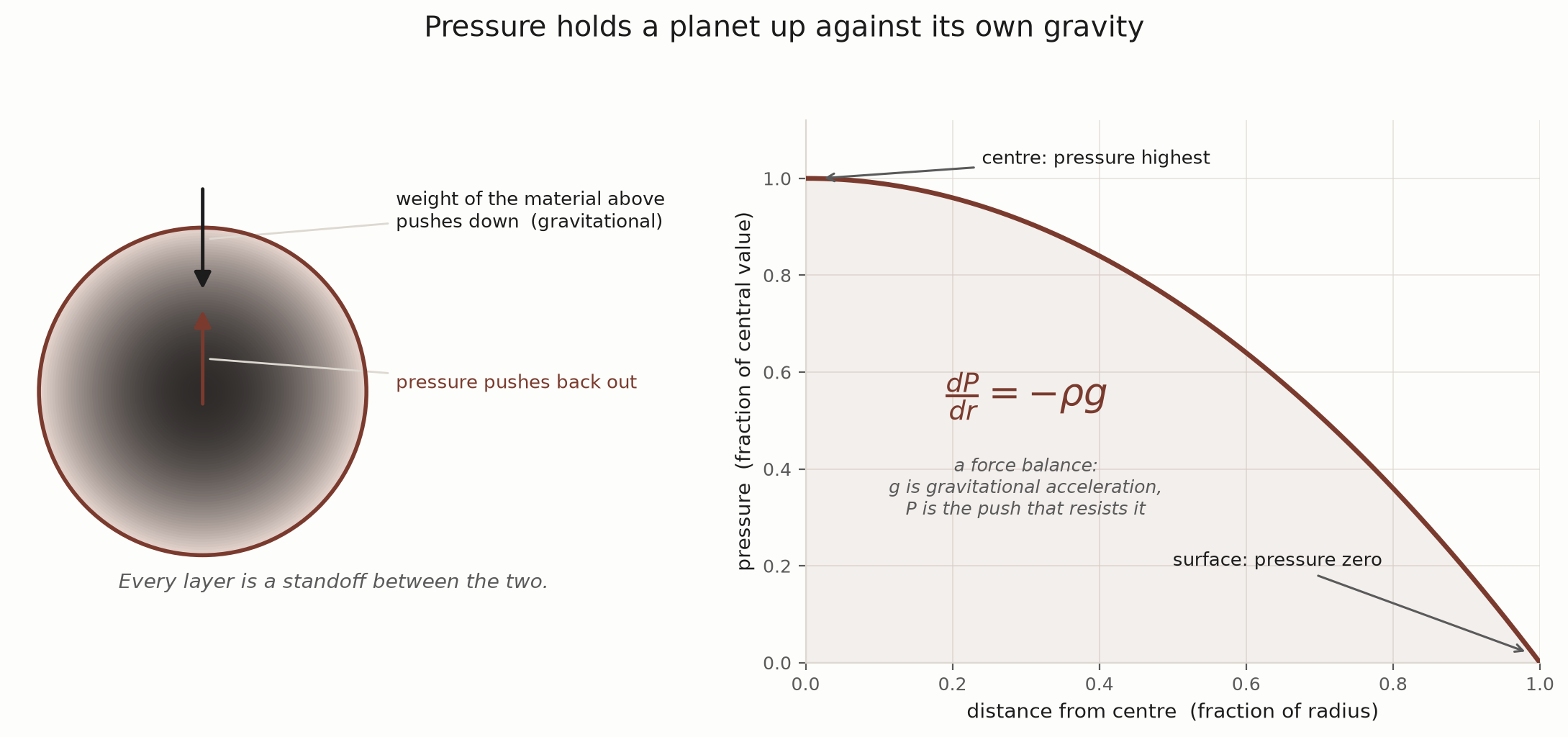
$$\nabla P = -\rho \nabla \Phi \qquad\text{or, in spherical symmetry,}\qquad \frac{dP}{dr} = -\rho(r)\, g(r)$$
Both symbols deserve naming plainly. $P$ is pressure, a push, measured in pascals, the same quantity that inflates a tire. And $g = -d\Phi/dr$ is gravitational acceleration — the gravitational body force per unit mass. That is the attraction. It would be a word game to call it anything else, and the first draft of this article played exactly that game.
So the equation is a standoff between two real things. Going down into a body, pressure rises, at a rate set by the density of the material and the strength of the local gravitational field. Every layer is being squeezed by the weight of everything above it — weight, a gravitational force — and pushes back exactly hard enough not to be crushed further.
Set $g = 0$ and the whole thing evaporates: $dP/dr = 0$, uniform pressure, no structure, nothing to round. Gravity is not decoration in this equation. It is the entire source term.
Why the equilibrium shape is a sphere
Here is the part that actually answers the shape question, and it takes one more step than “pressure pushes outward.”
Start from $\nabla P = -\rho\nabla\Phi$ and take the curl of both sides. The curl of a gradient is identically zero, so $\nabla\rho \times \nabla\Phi = 0$. Density is therefore a function of the potential alone — and so is pressure: $P = P(\Phi)$.
That has a direct consequence. Surfaces of constant pressure coincide exactly with surfaces of constant gravitational potential. The free surface, where $P = 0$, is therefore an equipotential.
For an isolated, non-rotating, self-gravitating body, that equipotential is a sphere.
So the sphere is chosen by the shape of the gravitational potential, not by the pressure. What pressure supplies is the mechanism that gets the fluid there — and that half is worth seeing directly.
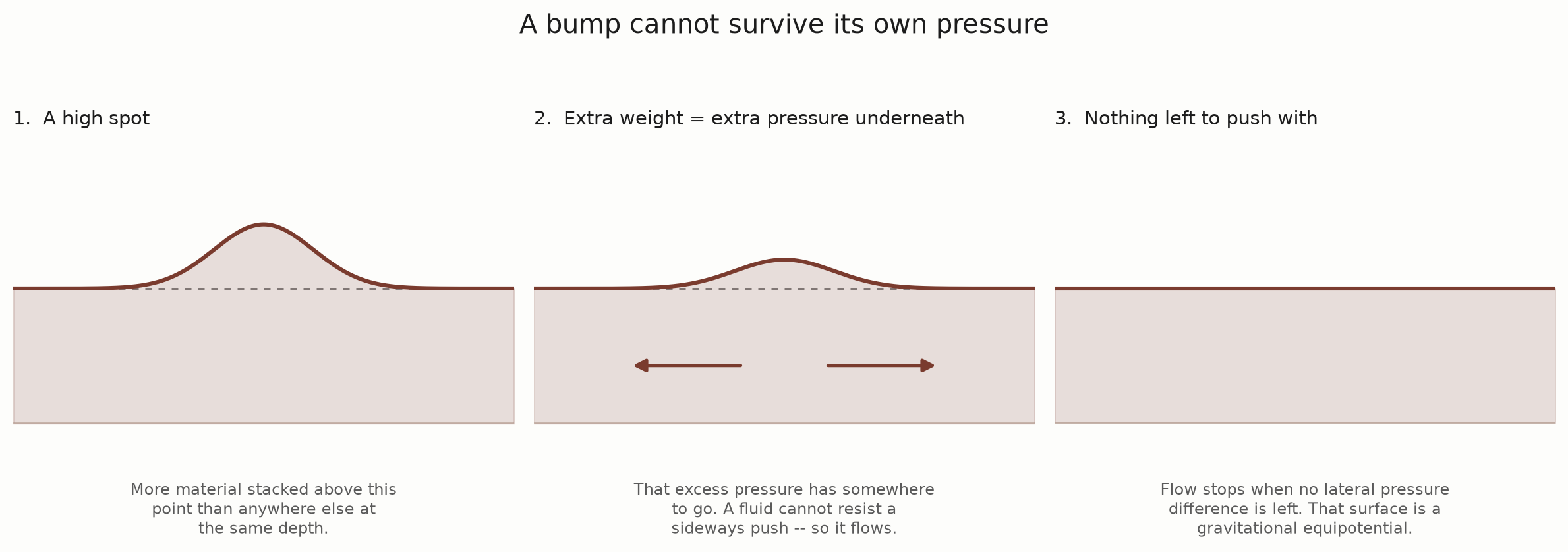
A fluid at rest cannot support shear stress — that is what makes it a fluid. So suppose the body has a bump. The material beneath it carries more overburden than material at the same depth elsewhere, so it sits at higher pressure. Pressure differences in a fluid drive flow, from high toward low. The excess pushes sideways, the bump slumps, the hollow fills, and this continues until no lateral pressure difference is left anywhere — which, by the argument above, is exactly the condition that the surface has become an equipotential.
Both verbs are doing real work, and the division is clean. The mechanical agent that erases topography is pressure-driven flow. The thing that decides what “level” means is gravity. There is no third force, and no extra “rounding pull” beyond the ordinary gravitational field already in the equation.
(One caveat on the isotropy: that a static fluid’s stress is isotropic follows from “no shear stress” directly. Pascal’s principle — from a treatise he wrote around 1653, published posthumously a decade later — is the closely related statement about how an applied pressure transmits through a confined fluid. They are usually taught together and are not quite the same claim.)
Real numbers, and where the simple version breaks
The simplest model is a sphere of uniform density. Integrate the equation above and the central pressure is:
$$P_c = \frac{2}{3}\pi G \rho^2 R^2$$
Earth’s mean density follows from its measured mass and radius: 5,513 kg/m³. With $R = 6{,}371$ km:
$$P_c \approx 1.73 \times 10^{11}\ \text{Pa} \approx 172\ \text{GPa}$$
Earth’s actual central pressure, from the PREM seismic model, is about 364 GPa. The simplest possible model lands within a factor of 2.1, using nothing but $G$, a mass, and a radius.
It is low for a specific reason, and the reason generalises. For a fixed mass and radius, any density profile that decreases outward puts more mass deep and therefore raises the central pressure above the uniform-density value. So that 172 GPa is a genuine lower bound for Earth’s mass and radius, not an approximation that happens to come out slightly under.
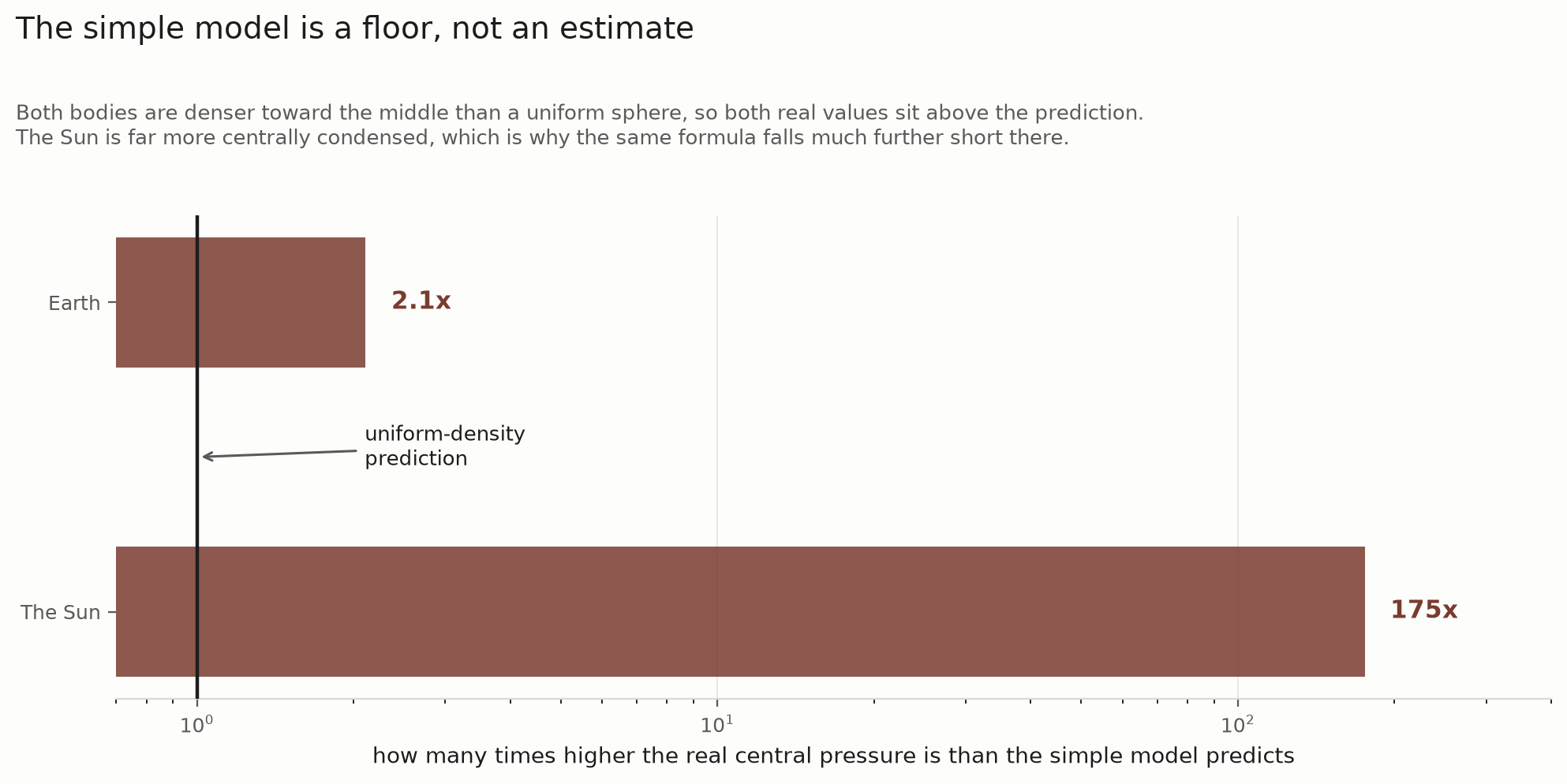
How far can that bound sit from reality? Run the same formula on the Sun and it returns about $1.3 \times 10^{14}$ Pa, against roughly $2.36 \times 10^{16}$ Pa in Bahcall’s BS2005 standard solar model — short by a factor of about 175. The Sun is enormously more centrally condensed than Earth. The uniform-density model earns its keep as a first cut for a rocky planet and stops being informative for a star; anyone quoting it should say which of the two they are doing.
Getting closer means integrating the same equation through a real density profile. It does not mean adding a new force.
Where the push runs out
Hydrostatic equilibrium assumes the material can flow. Rock is not a fluid on short timescales — over geological time and under enough pressure it behaves like one, but only where the pressure beats the material’s own strength.
So there is a threshold, and it shows up in the solar system as a rough sorting by size:
- Ceres, 939.4 km across, is round. The IAU’s dwarf-planet definition turns on exactly this clause — a body with “sufficient mass for its self-gravity to overcome rigid body forces so that it assumes a hydrostatic equilibrium (nearly round) shape.”
- Vesta, 525.4 km across, is not. A 2012 analysis of Dawn spacecraft shape and gravity data concluded Vesta is not currently in hydrostatic equilibrium, and the roughly 500 km Rheasilvia basin at its south pole is still sitting there unrelaxed.
The sorting is real, and messier than that pairing suggests. Three qualifications, all cutting against the tidy version:
The threshold does not track size cleanly. Saturn’s moon Mimas, 396.4 km across, is generally described as the smallest body rounded by its own gravity. Neptune’s moon Proteus, about 420 km across, is larger and is not round: its shape departs from a sphere by as much as 20 km and is better described as an irregular polyhedron. It sits close to the largest a body of its density can get without gravity rounding it. The bigger one is the lumpier one, because composition and thermal history decide whether the material could ever flow, and those do not follow size alone.
Round today does not prove equilibrium today. A 2014 study of Mimas’s libration concluded its present interior is not in hydrostatic equilibrium, pointing to either an elongated core or an internal ocean — so its round shape may be a frozen-in figure from an earlier, warmer period rather than a currently maintained balance. Roundness is the observable; equilibrium is a claim about what is producing it, and the two can come apart.
Even the textbook case is not exact. Ceres is close to hydrostatic equilibrium, and some deviations from an equilibrium shape have yet to be explained.
“Enough pressure and it flows round” is right. “Big enough and it goes round” is only roughly right, and even the bodies that look settled are still being argued about.
Rotation changes the target
If the sphere is an equipotential, then changing the potential should change the shape — and it does, measurably.
Earth rotates. In the rotating frame that adds a centrifugal term, so the surface settles onto an equipotential of $\Phi - \frac{1}{2}\omega^2 s^2$ instead of $\Phi$ alone. That surface is not a sphere but an oblate spheroid:
- Equatorial radius: 6,378.137 km
- Polar radius: 6,356.752 km
- Difference: 21.4 km, a flattening of about 1/298
Twenty-one kilometres of bulge, and it is not a correction bolted onto a spherical answer — it is the same equipotential argument with one more term in the potential. Saturn, less dense and spinning faster, is flattened by about a tenth of its radius and looks visibly squashed in a small telescope.
This is the cleanest demonstration that gravity picks the target: change the potential and the equilibrium figure changes with it, while the pressure mechanism carries on doing exactly what it did before.
Try it on something else
Two minutes with a calculator, and it is the argument in miniature. Take any rocky body’s mass and radius from a public fact sheet, then run:
$$\rho = \frac{M}{\frac{4}{3}\pi R^3} \qquad\text{then}\qquad P_c = \frac{2}{3}\pi G \rho^2 R^2$$
Three worked answers to check yourself against, with $G = 6.674 \times 10^{-11}$:
| Body | Mean density | Uniform-density $P_c$ |
|---|---|---|
| Mars | 3,934 kg/m³ | 24.9 GPa |
| Mercury | 5,427 kg/m³ | 24.5 GPa |
| The Moon | 3,344 kg/m³ | 4.7 GPa |
Then look at the first two rows. Mars has a 39% larger radius than Mercury and lands at essentially the same central pressure, because Mercury is denser by very nearly the factor needed to cancel Mars’s size advantage — $\rho$ and $R$ both enter squared. Size alone was never the variable, which is an analogous moral to the Mimas-and-Proteus pair, arrived at from arithmetic instead of a spacecraft visit.
What you have computed is the pressure required to hold that body up against its own gravity. The output is a pressure; the input is $G$, a mass, and a radius. Both halves are in there, which is the point.
What this does not say
This site develops Pressure-Based Theory, which proposes that gravity itself is a push — matter driven inward by an ambient particle medium. Nothing in this article supports that, and the distinction needs stating flatly because the vocabulary overlaps almost perfectly:
- Hydrostatic pressure is a measured, standard, universally accepted push — the pressure within a body, produced by its own material under its own weight. It explains how a body relaxes to its equilibrium figure.
- PBT’s proposed push is an unproven claim about the origin of the gravitational field itself — an external medium doing what mainstream physics assigns to spacetime curvature. This site’s own testing has found it failing by many orders of magnitude at atomic, nuclear, and galactic scales.
The first does not argue for the second. Everything above works identically whether the $\Phi$ in those equations comes from Newtonian attraction, spacetime curvature, or something not yet proposed — the equations are agnostic about the origin of the field, and that agnosticism is not evidence for any particular candidate.
And the thing this article most specifically does not say is that nothing pulls. An earlier draft was titled that way and argued it, and the argument does not survive: the working equation presupposes the central gravity it was claiming to have retired. What is true, and still worth knowing, is narrower — planetary roundness is hydrostatic equilibrium on gravitational equipotentials, the mechanical agent erasing topography is pressure-driven flow rather than any mysterious extra rounding force, and none of it requires this site’s theory.
Catalog status
Proven Systems. Hydrostatic equilibrium, the equipotential argument, Pascal’s principle, and the measured figures above are long-settled science. Nothing on this page is novel, and it would be wrong if it claimed to be.
See also
- What’s Actually Holding Us Down? — the free-fall and geodesic half, with measured time-dilation numbers
- Gravity Doesn’t Pull — But the Picture We Use to Say So Still Does — why the rubber-sheet illustration is circular
- Where Did We Get the Word “Pull”? — Newton’s own attractio and his caution about it
- Spheres in Nature — the four distinct routes to the same shape
- Soap Bubbles in Air — a pressure balance at a scale you can hold
References
- IAU (2006). Resolution B5, “Definition of a Planet in the Solar System” — source of the hydrostatic-equilibrium clause, quoted verbatim above. Text
- Dziewonski, A. M.; Anderson, D. L. (1981). “Preliminary reference Earth model.” Physics of the Earth and Planetary Interiors 25, 297–356 — PREM, source of the ~364 GPa central pressure and Earth’s density profile.
- Bahcall, J. N.; Serenelli, A. M.; Basu, S. (2005). Standard solar model BS2005-OP (astro-ph/0412440) — the tabulated central pressure used above, ~2.36 × 10¹⁶ Pa.
- Pascal, Blaise. Traité de l’équilibre des liqueurs — written around 1653, published posthumously in 1663 by Florin Périer.
- Einstein, Albert (1915). General Theory of Relativity — free fall as geodesic motion in curved spacetime, with no Newtonian force on a free test mass. Not a claim about continuum equilibrium, which is the TOV equation.
- Russell, C. T. et al. (2012). Dawn spacecraft shape and gravity analysis, establishing that Vesta is not currently in hydrostatic equilibrium.
- Tajeddine, R. et al. (2014). The Mimas libration measurement indicating a present interior not in hydrostatic equilibrium — either an elongated core or an internal ocean.
Figure provenance. Earth’s mean density, every uniform-density central pressure, the oblateness arithmetic, and the Mars/Mercury/Moon table were computed for this article from published masses and radii rather than quoted. The reference values they are measured against — Earth’s 364 GPa, the Sun’s ~2.36 × 10¹⁶ Pa, and the body diameters — were each checked against a primary or standard source. All three diagrams were generated from the site’s own CSS palette values.
Credits
Written 2026-08-06, out of a conversation that started with a soap bubble and the question of how air molecules find equilibrium at all.
This article was substantially rewritten before publication, and the reason is worth recording. The first draft was titled “Nothing Pulls a Planet Round” and argued that the hydrostatic equation contains no pulling term — that $g$ was merely “a rate.” A dedicated adversarial review pass took that apart correctly: $g$ is the gravitational body force per unit mass, the equation is a force balance, and setting $g = 0$ leaves no planet at all. The draft had also switched frameworks mid-article, claiming general relativity’s authority for an entirely Newtonian calculation, and had assigned the selection of the spherical shape to pressure when that job belongs to the gravitational equipotential. Those objections were verified independently — by re-deriving $P = P(\Phi)$ from the curl of the equilibrium condition — rather than taken on faith, and the thesis was rewritten rather than defended. One objection in the same pass was checked and rejected: it claimed the Sun’s central pressure should be 2.5 × 10¹⁶ Pa, but Bahcall’s published BS2005 model data gives ~2.36 × 10¹⁶, so the original figure stood and the ratio is 175 rather than 190.