Air Bubbles in Water: Conditions for Formation and Sustainment
July 2026
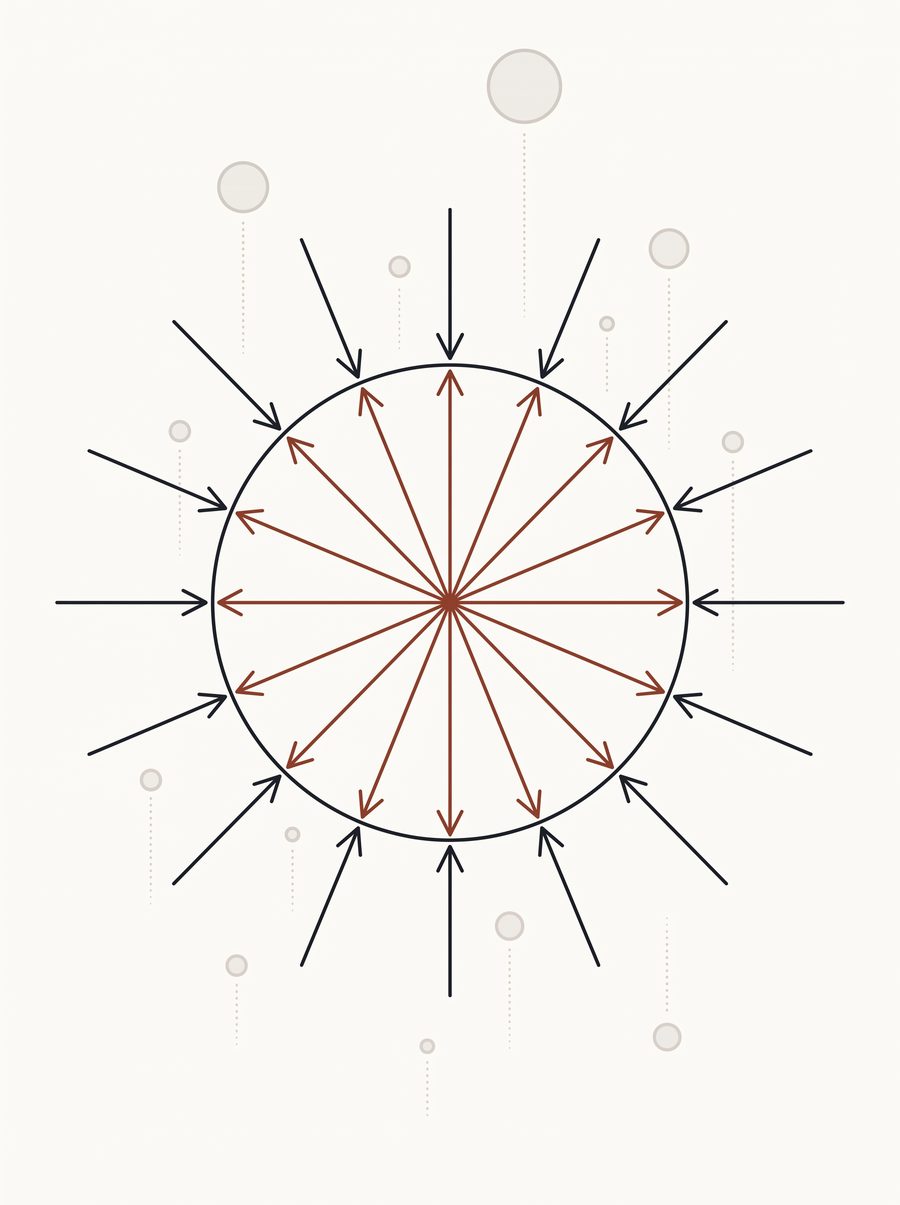
Generated via Gemini 3 Pro Image.
An air bubble in water looks like the simpler cousin of a soap bubble in air — just a pocket of gas surrounded by liquid, one interface instead of a two-surface film. It’s simpler in structure, but far less stable: unlike a soap bubble, a free-floating water bubble has no real path to lasting more than a few seconds or minutes under ordinary conditions, and understanding why is as important as understanding how it forms.
A single interface, half the restoring force
With only one air-water surface instead of a soap film’s two, the excess pressure inside the bubble is the plain Young-Laplace relation:
$$\Delta P = P_{\text{inside (air)}} - P_{\text{outside (water)}} = \frac{2\gamma}{r}$$
where $\gamma$ is the surface tension of the water-air interface and $r$ is the bubble’s radius — compare this to the $4\gamma/r$ a soap bubble in air needs, since that film has two surfaces working together instead of one.
Why “indefinitely” almost never happens
A free-floating air bubble in water cannot remain indefinitely under ordinary Earth conditions. Two irreversible processes are always working against it:
- Buoyancy drives the bubble upward — millimeter-scale bubbles at something like centimeters to tens of centimeters per second, while sub-micron bubbles are small enough that Brownian motion and drag dominate over buoyancy almost entirely, effectively non-buoyant on any practical timescale.
- Gas dissolves into the surrounding water by diffusion, driven by the bubble’s own excess internal pressure, unless the water is already fully saturated or supersaturated with air. (A related but distinct process, Ostwald ripening, describes a population of bubbles or droplets coarsening together — larger ones growing at smaller ones’ expense — rather than one isolated bubble’s own dissolution.)
True indefinite sustainment is only possible under highly restricted conditions:
- Zero gravity, combined with a fully gas-saturated liquid and no contaminants that promote coalescence, or
- Extremely small (nanoscale) bubbles that some research reports as metastable for hours to days under special surface-chemistry conditions — though bulk nanobubble longevity itself is still an actively debated area of research, not settled science; proposed explanations include surface contamination shells and dynamic equilibrium effects, and the same Laplace-pressure logic driving dissolution everywhere else in this entry would naively predict these should dissolve fastest of all, or
- The bubble is mechanically pinned, e.g. in a crevice or on a hydrophobic surface.
The table below gives the practical min/nominal/max values that allow formation and the longest possible metastable lifetime — not a recipe for a bubble that lasts forever, since under ordinary conditions nothing quite does that.
Conditions for formation and sustainment
| Parameter | Min | Nominal | Max | Units | Notes / role in sustainment |
|---|---|---|---|---|---|
| Air temperature (inside bubble) | 0 | 20 | 40 | °C | Controls internal molecular speed and internal pressure. Near 0 °C slows dissolution; above 40 °C accelerates gas escape. |
| Air molecular speed (rms) | ~485 | ~500 | ~520 | m/s | Set by temperature and molecular mass ($v_{rms} = \sqrt{3kT/m}$). Higher speed raises internal kinetic pressure. |
| Air molecular size (kinetic diameter) | 0.346 (O₂) | 0.36 | 0.364 (N₂) | nm | Essentially fixed for ordinary air. Determines collision cross-section inside the gas phase. |
| Water temperature (outside) | 0 | 20 | 40 | °C | Strongly affects surface tension, viscosity, and gas solubility. Cold water favors longer bubble life. |
| Water molecular size (kinetic diameter) | 0.265 | 0.28 | 0.30 | nm | Fixed property of H₂O. Smaller than air molecules; influences packing at the interface. |
| Water molecular speed — instantaneous (equipartition) vs. effective (diffusive) | ~0.1–10 (diffusive) | ~615–660 (equipartition estimate) | ~700 (diffusive, upper bound) | m/s | An isolated H₂O molecule’s equipartition speed genuinely is several hundred m/s — this isn’t a meaningless number, but it’s not the number that governs bubble dissolution either. What actually controls how fast the bubble loses gas is diffusivity — how far a molecule’s motion actually carries it through the crowded liquid — which is the much slower diffusive figure. |
| Surface tension (water-air), $\gamma$ | ~58–60 (near 100 °C) | 72–73 | ~75–76 (near 0 °C) | mN/m | How strongly water molecules hold onto each other at the interface. Higher $\gamma$ increases $\Delta P$ and makes small bubbles more pressurized. Decreases with rising temperature. |
| Bubble radius, $r$ | ~50–100 nm (nanobubble regime) | 0.1–1 mm (typical visible bubble) | several mm | nm or m | Critical parameter — $\Delta P$ scales as $1/r$. Nanobubbles are reported metastable for long periods in some studies (see caveat above); macroscopic bubbles rise and dissolve quickly. |
| Pressure difference, $\Delta P = 2\gamma/r$ | ~0.05 kPa (~0.0005 atm, 3 mm radius) | ~1.5 kPa (~0.014 atm, 0.1 mm radius) | ~1,500 kPa (~14 atm, 100 nm radius) | kPa (atm shown per cell) | Direct consequence of curvature and surface tension, computed here from $\gamma\approx72.8$ mN/m. A bubble a few mm in radius carries almost no excess pressure; a 100 nm-radius nanobubble carries roughly atmospheric-scale excess pressure — a real, large difference across the size range in this table. |
| External / hydrostatic pressure | ~1 atm (surface) | 1 to a few atm | high (deep water or pressurized vessel) | atm | Adds to the outside pressure. Higher external pressure reduces the relative importance of $\Delta P$ and can suppress bubble growth or dissolution. |
| Gas saturation of surrounding water | undersaturated (rapid dissolution) | saturated | mildly supersaturated | — | The single most important chemical factor for lifetime. Only near-saturated or supersaturated water allows long-lived bubbles. |
Key limits for the longest possible (metastable) life
- Radius: the nanobubble range ($r \lesssim 200$–500 nm) is where the longest reported lifetimes come from, though — worth repeating — the mechanism behind that longevity is still genuinely debated, not a settled explanation. Macroscopic bubbles almost always disappear within seconds to minutes regardless.
- Temperature: 0–20 °C. Lower temperature raises surface tension, lowers the rate of gas-solubility change, and slows diffusion.
- Surface tension: keep it high and clean — pure water, no surfactants that lower $\gamma$ excessively, unless the surfactants themselves stabilize the interface.
- Saturation: the surrounding water must be at or above air saturation; otherwise dissolution is rapid.
- Environment: still water, no turbulence, minimal temperature gradients, and ideally zero gravity or mechanical pinning for a true indefinite hold.
The pressure difference $\Delta P = 2\gamma/r$ is the one parameter doing double duty here — it’s what stabilizes the bubble’s spherical shape and, at the very same time, what drives the thermodynamic instability that eventually kills it, since that same excess internal pressure keeps forcing gas out into the surrounding liquid. Only when radius, temperature, saturation, and external pressure are all pushed into the ranges above does an air bubble in water get anywhere close to “indefinite” — and even then, it’s metastable, not permanent.
Where this touches PBT
Everything above — buoyancy, diffusion-driven dissolution, and the Young-Laplace relation — is standard, independently confirmed physics, and none of it depends on or is evidence for Pressure-Based Theory (PBT), this site’s own unproven alternative theory of gravity. The one thing worth naming plainly: $\Delta P = 2\gamma/r$ is a curvature-dependent pressure difference that both creates and eventually undoes the bubble’s equilibrium, which happens to share the same broad category of explanation — pressure balance rather than an attractive force — as PBT’s own proposed gravity mechanism (see the theory and Why Pressure). That’s a resemblance in the shape of the explanation only: Young-Laplace pressure is a rigorously derived, experimentally confirmed consequence of intermolecular forces and interface geometry, while PBT’s mechanism is a hypothesized medium with no comparable confirmation. A water bubble’s instability comes entirely from ordinary gas solubility, diffusion, and buoyancy — nothing here needs, uses, or supports PBT’s proposed medium.
Catalog status: Proven Systems
Buoyancy, diffusion-driven dissolution, and the Young-Laplace relation are long-settled, independently confirmed science. The one open question flagged within this entry — exactly why some bulk nanobubbles persist far longer than simple Laplace-pressure dissolution would predict — is real, active research, not a disputed claim made by this entry itself.
See also
- Soap Bubbles in Air — the two-surface film counterpart, and why it can hold a shape far more reliably than a bare water bubble
- Water Droplets in Air — the phase-reversed case: liquid inside, gas outside, instead of gas inside, liquid outside
- Spheres in Nature — the broader catalog this entry’s sphericity belongs to
- Recognizing Similarities in the Universe — bubbles and planets as parallel examples of isotropic-force sphericity
Built from a conversation with Grok, xAI, on a DOE-style parameter matrix for the formation and sustainment of an air bubble in water.