Critical Thresholds: The Sharp Lines That Aren't Phase Boundaries
October 2026

A T-38C Talon in supersonic flight over the Mojave Desert, photographed with NASA’s Air-to-Air Background-Oriented Schlieren (AirBOS) technique. The rippled cones are real shock waves, made visible by how they bend light passing through air of different density. Credit: NASA/US Air Force, J.T. Heineck, Ed Schairer, Maj. Jonathan Orso, Maj. Jeremy Vanderhal, public domain.
Water boils at a sharp, repeatable temperature. An aircraft “breaks the sound barrier” at a sharp, repeatable speed. Both get described the same way in casual speech: a wall, a line, a threshold the system crosses. States of Matter already covers the first one in full. This page is about the second one, and about why calling them the same kind of thing is a mistake worth naming precisely rather than waving past.
What a phase boundary actually is
The short version, covered in depth on the states-of-matter page linked above: a phase boundary is a thermodynamic equilibrium condition. Two forms of a substance, say liquid water and water vapor, can coexist side by side with equal free energy. Cross the line and one form stops being favorable and the other takes over. That is why boiling has a latent heat: energy goes into converting molecules from one coexisting form to the other, not into raising the temperature further, and the thermometer sits flat on a boiling pot until the conversion finishes.
The defining feature is the word coexist. At exactly 100°C and one atmosphere, liquid water and steam are both genuinely present and both genuinely stable, side by side, in equilibrium.
The other kind of sharp line
Nothing coexists at Mach 1. There is no form of air that is stable below the speed of sound and a different, equally stable form that takes over above it. An aircraft accelerating through Mach 1 doesn’t convert anything from one state into another. The air is the same air, obeying the same equations, the entire time.
What changes is the relationship between the aircraft’s speed and the speed at which the air ahead of it can get out of the way. Below Mach 1, pressure disturbances radiate forward and the air “feels” the aircraft coming and starts moving aside before it arrives. At Mach 1, the aircraft catches up to its own pressure wave. Air can no longer be warned in advance, so it gets compressed abruptly instead of smoothly, and that abrupt compression is a shock wave: the rippled cones in the photograph above.
This is a critical threshold, not a phase boundary. It is defined by a dimensionless ratio, the Mach number (aircraft speed divided by local sound speed), crossing a critical value of exactly 1. Nothing about the air’s identity changes. What changes is a regime of behavior: how pressure disturbances propagate relative to the object moving through them.
The “wall” test pilots described in the 1940s was real, but it was a drag spike, not a material barrier. As an aircraft nears Mach 1, shock waves forming on its surfaces convert a large share of engine thrust into wave drag, a kind of resistance that barely exists at low speed and dominates right near the threshold, then falls off again once the aircraft is cleanly supersonic. Capt. Chuck Yeager flew the Bell X-1 through that drag spike and reached Mach 1.06 at 43,000 feet on October 14, 1947, the first confirmed supersonic flight. The aircraft didn’t pass through a wall. It passed through a peak in drag, produced by exactly the shock-wave pattern photographed above.
Other critical thresholds, same shape, different domains
The sound barrier isn’t a special case. The same pattern, a measurable quantity crossing a critical value and flipping a system’s behavior, shows up across fields that have nothing else in common. Mach, Reynolds, and Froude numbers are the textbook dimensionless versions; yield strength and escape velocity are the same shape of threshold, stated as a plain physical quantity instead of a ratio:
| Threshold | Critical value | What flips |
|---|---|---|
| Mach number | = 1 | Subsonic → supersonic airflow; shock waves form, wave drag spikes |
| Reynolds number | roughly 2,000–4,000 in pipe flow | Smooth, layered (laminar) flow → chaotic, mixing (turbulent) flow |
| Froude number | = 1 | Subcritical → supercritical open-channel flow; a hydraulic jump forms at the crossing |
| Yield strength | stress exceeds the material’s yield point | Elastic (springs back) → plastic (permanently deforms) |
| Cherenkov threshold | particle speed exceeds light’s phase velocity in that medium | No radiation → Cherenkov radiation emitted |
| Escape velocity | total mechanical energy crosses zero | Bound orbit (ellipse) → unbound trajectory (hyperbola) |
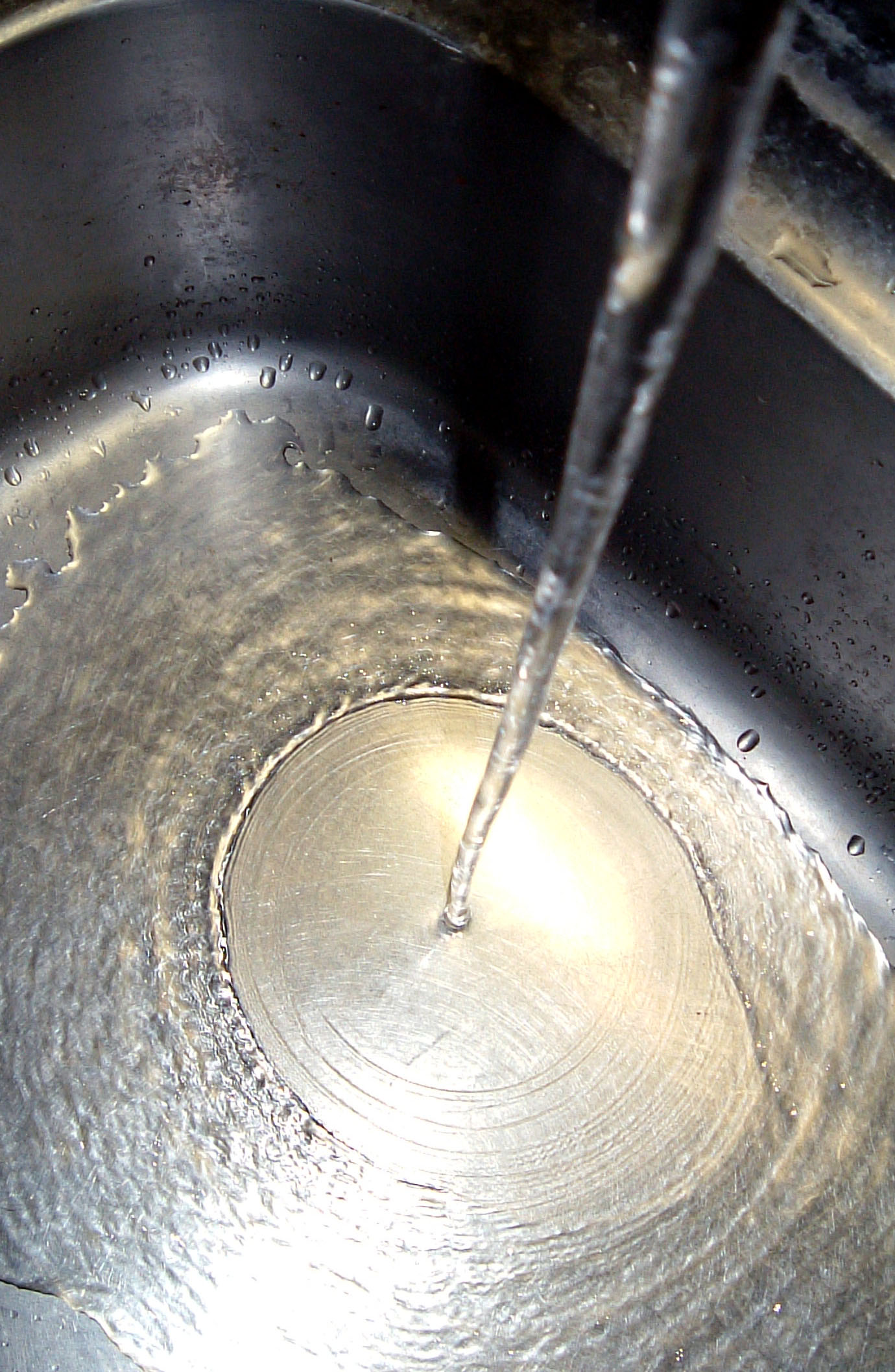
A hydraulic jump in a kitchen sink: the sharp ring where the thin, fast sheet of water spreading from the faucet’s impact point (Froude number above 1) abruptly thickens into the slower, rougher water beyond it (Froude number below 1). The same threshold shape that governs the Mach-1 shock front, worked out at sink scale. Credit: James Kilfiger, via Zeimusu on Wikimedia Commons, CC BY-SA 3.0.
The Reynolds-number row states something the others don’t: that transition is a band, not a sharp point. Real pipe flow can stay laminar well past 2,000 or trip into turbulence a little earlier, depending on how much the flow is disturbed going in. Mach 1 and Froude 1 are sharp in the idealized case; pipe-flow turbulence is sharp in principle but smeared by real-world sensitivity to small disturbances. Worth stating plainly rather than picking a single falsely precise number.
Why the distinction earns its keep
A phase boundary answers a question about equilibrium: at this temperature and pressure, which form has the lower free energy? A critical threshold answers a question about regime: at this speed, this stress, this flow rate, which behavior governs?
Those are different questions, with different kinds of evidence behind them. Showing that two states have equal free energy at a boundary is a thermodynamic calculation. Showing that a dimensionless ratio crosses 1 is a kinematic or dynamical one. Treating a regime change as though it carries the weight of an equilibrium phase transition, or the reverse, is a category error: it borrows the authority of one kind of physics for a claim that’s actually a different kind.
Where this touches PBT
Pressure-Based Theory’s working model occasionally reaches for boundary language, including, in current internal discussion, phase-transition language, to describe configurations of its proposed medium. This page exists so that language has a fixed standard to check against: a real phase boundary requires an actual equal-free-energy condition between two coexisting states, the same bar States of Matter applies to boiling, freezing, and every other entry on that page. A dimensionless ratio crossing a critical value, however dramatic the behavior change on either side, is the other kind of thing, the kind this page is about, and doesn’t qualify on its own.
Whether any specific feature of the PBT model meets the phase-boundary bar is an open question, decided the same way every other PBT claim is: by deriving the actual equilibrium condition and checking it, not by analogy to how dramatic the crossing feels. No specific PBT calculation is reported on this page, and none is implied by its existence.
Catalog status: Proven Systems
Everything on this page, the thermodynamics of phase boundaries, the aerodynamics of transonic flight, the fluid dynamics of the Reynolds and Froude numbers, the mechanics of yield, Cherenkov radiation, and orbital mechanics, is established, independently confirmed physics. The PBT section above names an open question about vocabulary, not a result, and reports nothing new.
Notes on sources, and how firm each claim is
- Firm. The thermodynamic definition of a phase boundary, the Mach-number definition and the shock-wave/wave-drag mechanism, the Reynolds/Froude/yield/Cherenkov/escape-velocity definitions: textbook fluid dynamics, aerodynamics, and classical mechanics.
- Verified against primary sources, not memory. Yeager’s October 14, 1947 flight (Mach 1.06, 43,000 feet) was checked against NASA’s own history pages rather than recalled. The AirBOS schlieren photograph’s date, credited photographers, and public-domain status were read directly from its Wikimedia Commons file page, not assumed from familiarity with NASA’s general image policy.
- Deliberately hedged. The Reynolds-number critical range is given as roughly 2,000–4,000 rather than a single number, because real pipe-flow transition is sensitive to disturbance level and isn’t a sharp point the way Mach 1 or Froude 1 are. Stated as a feature of the physics, not an uncertainty in the research.
- Not independently derived here. This page reports established results and contains no original calculation; there is nothing in it to check by recomputation.
- Checklist items resolved n/a, with reason: item 3 (privacy/names), no personal information or named private individuals beyond public historical figures and credited photographers. Item 5 (affiliate disclosure), no commercial links. Item 9’s closing-action structure (corrective action, proof it worked, best-practice comparison), this is an explainer page reporting no problem found or fixed, the same page type as States of Matter, which this page follows for structure.
Image credits
- T-38C shock-wave schlieren photograph, AirBOS program, February 2015. Credit: NASA/US Air Force, J.T. Heineck, Ed Schairer, Maj. Jonathan Orso, Maj. Jeremy Vanderhal, public domain.
- Hydraulic jump in a kitchen sink, January 2005. Credit: James Kilfiger, via Zeimusu on Wikimedia Commons, CC BY-SA 3.0.
See also
- States of Matter (the full thermodynamic treatment of real phase boundaries this page is the companion to)
- Air Bubbles in Water, Soap Bubbles in Air, Water Droplets in Air (phase boundaries worked out in full detail for three specific cases)
- Physics Catalog (how this site classifies the epistemic status of everything it covers)
Written 2026-10-23, prompted by a question Matthew asked after a live internal STU discussion used phase-transition language for a model feature under active, unfinished calculation, and asked how to tell that kind of claim apart from a critical-threshold claim like the sound barrier. No detail of that internal calculation appears on this page, which covers only the general, settled physics of the distinction itself.