Soap Bubbles in Air: Conditions for Formation and Sustainment
July 2026
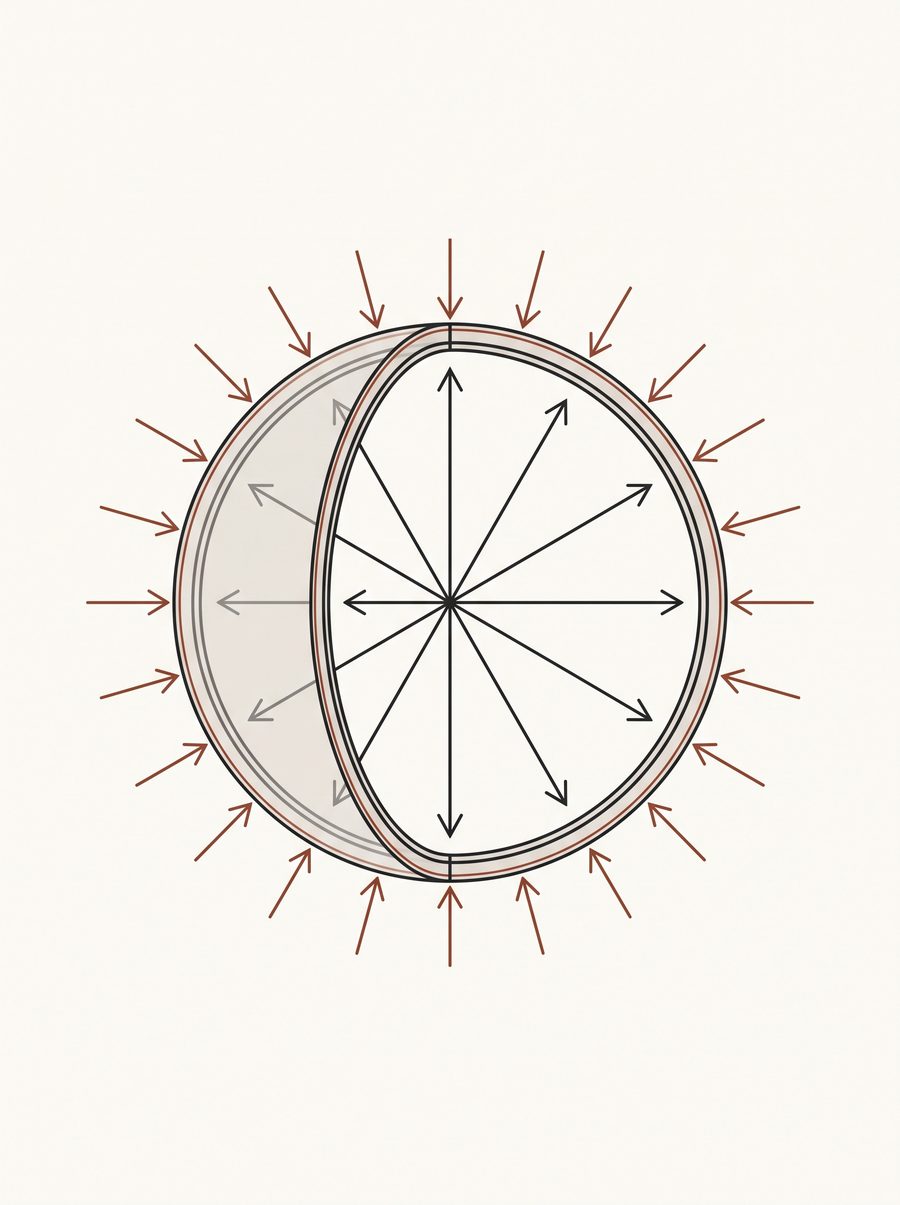
Generated via Gemini 3 Pro Image.
A soap bubble is a sphere of ordinary room air, held together by a liquid film — typically tens to hundreds of nanometers thick when freshly blown, thinning further as it drains and evaporates, sometimes down to a genuine few-molecule-thick “black film” in the seconds right before it pops — floating in a sea of that same air. It shouldn’t be possible for something that fragile to hold a shape at all — and the reason it does comes down to a handful of physical conditions that all have to line up at once.
Why it settles into a sphere
Surface tension pulls the soap film toward the smallest possible surface area for whatever volume of air it’s enclosing. Of every shape that could enclose a given volume, the sphere has the least surface area — so that’s the shape the film settles into, the same isotropic-force logic behind every other sphere in nature. The bubble stops expanding right at the point where the outward push of the enclosed air’s pressure exactly balances the inward pull of the film’s own surface tension.
The enclosed air’s role in that balance is narrower than it first appears, and it’s worth stating plainly up front: the trapped gas fixes how big the bubble is, while surface tension determines what shape it takes. Those are two different jobs, and it is easy to read the pressure balance above as though the air were inflating the film into roundness. It isn’t — the pressure involved turns out to be far too small to shape anything, as How the equilibrium is actually reached works through below.
The pressure balance
A soap film has two surfaces — an inner one and an outer one, with a thin layer of liquid between them — unlike a single water-air interface. That doubles the restoring force, so the excess pressure inside a soap bubble is:
$$\Delta P = \frac{4\gamma}{r}$$
where $\gamma$ is the surface tension of the soap solution and $r$ is the bubble’s radius. This is the working half of the Young-Laplace relation for a two-surface film — the same relation shows up with a factor of 2 instead of 4 for a single-interface bubble (see Air Bubbles in Water for that case).
How the equilibrium is actually reached
The relation above says where the balance sits. It doesn’t say how the air gets there — and the mechanism is not the one most descriptions imply.
How far an air molecule actually travels
Kinetic theory answers this directly. For dry air at 20 °C and 1 atm, taking an effective collision diameter of 3.7 Å:
| Quantity | Value |
|---|---|
| Number density | 2.50 × 10²⁵ molecules/m³ |
| Mean free path $\lambda$ | 65.7 nm |
| $\lambda$ expressed in molecular diameters | ~177 |
| Mean speed $\bar{v}$ | 463 m/s |
| Root-mean-square speed $v_{\text{rms}}$ | 503 m/s |
| Collisions per molecule per second | 7.05 × 10⁹ |
| Time between collisions | 0.14 nanoseconds |
Two ways to feel that. Scale a nitrogen molecule up to the size of a golf ball, and it flies roughly 7.6 meters between collisions — gases are mostly empty space, which is why they compress at all. And a 10 cm bubble is about 1.5 million mean free paths across.
One comparison is worth pausing on. A soap film in its drained “black film” stage is thinner than 65.7 nm. The wall of the bubble is a thinner barrier than the distance a single air molecule covers between collisions — the film holds not because it is a substantial obstacle, but because of how the interface transfers momentum.
Equilibrium is reached by sound, not by travel
No molecule surveys the bubble. At seven billion collisions per second, a pressure difference does not propagate by molecules crossing the interior — it propagates as a sound wave, at 343 m/s. Across a 10 cm bubble that is one crossing every 0.29 milliseconds.
The bubble’s shape, by contrast, relaxes far more slowly: capillary oscillation lands in the milliseconds-to-tenths-of-a-second range — the visible wobble as a bubble pinches off the wand. So the gas finishes re-equilibrating roughly two to three orders of magnitude faster than the film can meaningfully move.
That gap is what licenses the equation in the previous section. Young-Laplace requires a single, uniform interior pressure to put on the left-hand side. That is legitimate only because the gas is always finished settling before the surface has changed shape. Without the separation of timescales there would be no well-defined $\Delta P$ to write down at all — the assumption is doing real work, and it is earned rather than free.
What the enclosed air is actually doing
Put a number on the pressure excess. For a 10 cm bubble at $\gamma = 25$ mN/m, $\Delta P = 4\gamma/r$ gives 2.0 Pa. The air inside sits at about 101,325 Pa and pushes outward harder than the room pushes in by two pascals — roughly one part in fifty thousand. A smaller 1 cm bubble reaches only 20 Pa, one part in five thousand.
That is nowhere near enough to shape anything. The enclosed gas is stiff — the bulk modulus of an ideal gas is simply its pressure, about 101 kPa — so against a 2 Pa nudge it behaves as an almost perfectly fixed volume rather than as a sculptor. The air supplies the volume constraint; the film supplies the shape.
The clean control for this already sits elsewhere in this catalog: a water droplet in free fall, or in microgravity, encloses no gas at all and is still a sphere (see Water Droplets in Air). Molten lead dropped down a shot tower does the same thing. Remove the enclosed gas entirely and sphericity survives; remove surface tension and there is no bubble to discuss.
Why the sphere is the only answer, not merely the best one
The least-area argument at the top of this entry establishes that the sphere is the minimum. A second, stronger route establishes that it is the only possibility.
$\Delta P$ is uniform, for the reasons just given, and gravity’s density gradient across 10 cm of air is negligible. $\gamma$ is uniform. By $\Delta P = 4\gamma/r$, the mean curvature must therefore be identical at every point on the surface. Alexandrov proved in 1958 that the only closed, non-self-intersecting surface in three-dimensional space with constant mean curvature is the sphere.
The non-self-intersecting condition earns its place in that sentence rather than being a technicality: drop it and other constant-mean-curvature surfaces do exist — Wente constructed a self-intersecting torus in 1986. A real soap bubble does not pass through itself, so for the physical case the sphere is not the preferred solution among several candidates. It is the only one.
Two very different kinds of molecular motion
Everything inside and around the bubble is made of molecules in motion, but not in the same way. The air molecules — both the ones trapped inside the bubble and the identical ones outside it — are flying freely at roughly 500 m/s at room temperature, set almost entirely by temperature and molecular mass ($v_{\text{rms}} = \sqrt{3kT/m}$), covering about 66 nm between collisions — the mean free path worked out in the table above.
The soap molecules in the film are a genuinely different story, and it’s worth being precise about how. Equipartition still applies to a liquid — a typical surfactant molecule (SDS, a common soap ingredient, at ~288 g/mol) works out to roughly 150–160 m/s by the same formula, only a few times slower than an air molecule, not “hundreds of times” slower. What actually is hundreds to thousands of times slower is how far that motion gets a soap molecule: packed shoulder-to-shoulder with its neighbors in the film, it’s knocked off course almost immediately, so its net drift — the diffusive, effective speed that determines how the film actually rearranges and flows — is more like 0.1–1 m/s. The air molecules aren’t being held back by a slow-moving wall; they’re being held back by intermolecular forces and momentum transfer at the interface, the same physics behind any liquid surface. What’s genuinely different between the two phases isn’t raw molecular speed so much as how far each molecule is free to travel before something gets in its way.
Conditions for formation and sustainment
| Factor | Symbol | Units | Nominal value for good formation | Practical range for formation & sustainment | Notes / why it matters |
|---|---|---|---|---|---|
| Air temperature | $T_{air}$ | °C (°F) | 15–20 °C (59–68 °F) | ~ –15 to +24 °C (5–75 °F) — see temperature limits below | Controls molecular speeds and film stability. Below ~–15 °C bubbles freeze outright; above ~24–25 °C evaporation and thinning accelerate popping. |
| Air molecular speed (rms thermal) | $v_{air}$ | m/s | ~498–503 | ~472–506 (across the full –15 to +24 °C range above) | Determined almost entirely by temperature and molecular mass. Higher speed means higher internal pressure for a given density. Note this is the rms speed; the mean speed $\bar{v}$ is lower, ~463 m/s at 20 °C — both appear in the kinetic-theory table earlier in this entry. |
| Air molecular size (kinetic diameter) | $d_{air}$ | nm (Å) | 0.36 (3.6 Å) | Essentially fixed: N₂ ≈ 0.364 nm, O₂ ≈ 0.346 nm | Collision cross-section — fixed for ordinary air, doesn’t change with normal conditions. |
| Soap film / solution temperature | $T_{soap}$ | °C | Same as air (15–20 °C) | Same practical range as air temperature | Almost always equal to room air temperature. Controls viscosity, evaporation rate, and surface tension of the film. |
| Soap molecular size (typical surfactant length) | $L_{soap}$ | nm | ~2.0–2.2 | 1.8–2.5 (for common soap surfactants) | Length of the amphiphilic molecule. Determines packing density in the film’s two monolayers. Fixed for a given soap chemistry. |
| Soap molecular speed — instantaneous (equipartition) vs. effective (diffusive) | $v_{soap}$ | m/s | ~150–160 (equipartition) / ~0.1–1 (diffusive) | Equipartition estimate a few times slower than air; diffusive/effective motion hundreds to thousands of times slower | Liquid-phase molecules move at a real, equipartition-driven instantaneous speed comparable in order of magnitude to a gas molecule’s — what’s actually slow is how far that motion carries a molecule before a neighbor blocks it, which is what the diffusive figure captures. |
| Intermolecular cohesion / film strength (surface tension) | $\gamma$ | mN/m (dyn/cm) | 25–30 | ~20–35 for stable bubbles | Quantifies how well the soap molecules hold onto each other. Pure water alone is ~72 mN/m and can’t hold a stable free film — not primarily because that number is “too high,” but because pure water lacks the Gibbs-Marangoni elasticity a surfactant provides (a local tension gradient that resists thinning and self-heals thin spots). Soap’s lower $\gamma$ is a real contributor, but the surfactant’s stabilizing behavior is the bigger piece of the answer. |
Key relationships:
- Air molecular speed isn’t an independent knob — it’s fixed the moment temperature and molecular mass/size are set.
- Soap molecular size and speed are properties of the liquid film’s chemistry and temperature; they change little once the soap solution is mixed.
- Surface tension ($\gamma$) is the most directly tunable parameter in this specific table — controlled by soap concentration, additives (glycerin, polymers), and temperature — but it’s not the only real-world variable that matters. Humidity, film drainage under gravity, Marangoni self-healing, and dust or other nucleation sites all affect a real bubble’s lifetime and aren’t captured in this simplified parameter set.
- Temperature shows up twice — the film’s own temperature drives evaporation and thinning, while the enclosed air’s temperature drives expansion and contraction of the bubble’s volume.
Temperature limits in practice
Soap bubbles can form across roughly 5°F to 75°F (–15°C to +24°C), with the most reliable formation in the upper half of that range (5°F/–15°C is close to where they start freezing outright rather than just struggling). Right around and below 5°F they freeze in the air and often shatter rather than pop. Above about 75°F they still form, but evaporation and thinning accelerate enough that they pop noticeably faster than a bubble blown at room temperature.
Where this touches PBT
Everything above is ordinary, independently confirmed surface-tension physics — that’s the whole content of this entry, and none of it depends on or is evidence for Pressure-Based Theory (PBT), this site’s own unproven alternative theory of gravity. The one thing worth naming plainly: a soap bubble exists because an internal pressure and an external restoring force reach equilibrium at a specific radius, which happens to be the same general category of explanation — pressure balance rather than an attractive force — that PBT proposes for gravity (see the theory and Why Pressure). That’s a resemblance in the shape of the explanation, nothing more: soap-film equilibrium is molecular surface chemistry with a rigorously derived, experimentally confirmed formula behind it; PBT’s proposed mechanism is a hypothesized bulk medium with no comparable experimental confirmation. The parallel isn’t evidence PBT is correct, and PBT doesn’t explain anything about why soap bubbles work — ordinary Young-Laplace physics already does that completely.
Catalog status: Proven Systems
Surface tension, the Young-Laplace relation, and the kinetic-theory figures in the tables above are long-settled, independently confirmed science — nothing in this entry is a novel or disputed claim. The same holds for the mathematics: the isoperimetric theorem and Alexandrov’s 1958 uniqueness result for constant-mean-curvature surfaces are proven theorems, not physical models awaiting confirmation.
See also
- Air Bubbles in Water — the single-interface counterpart to this two-surface film, and why a water bubble can’t sustain itself the way a soap bubble in air does
- Water Droplets in Air — the phase-reversed case: liquid inside, gas outside, instead of a thin film of liquid with gas on both sides
- Spheres in Nature — the broader catalog this entry’s sphere-forming logic belongs to
- Recognizing Similarities in the Universe — bubbles and planets as parallel examples of isotropic-force sphericity
Built from a conversation with Grok, xAI, on the physics of soap bubble formation and a DOE-style parameter matrix for its formation and sustainment in air.
Rev 2 — 2026-08-06. The “How the equilibrium is actually reached” section was added from a follow-up conversation asking a question the original entry asserted an answer to without ever addressing: how the enclosed air reaches equilibrium in the first place, and how far an air molecule actually travels between collisions. The original stated the pressure balance but never gave the mean free path, never explained that equilibration happens by sound propagation rather than molecular transit, and never quantified $\Delta P$ — which turns out to be about one part in fifty thousand of atmospheric pressure, small enough that the framing of trapped air as a shaping force needed correcting. Alexandrov’s uniqueness theorem was added to upgrade the sphere argument from “least area” to “only possible surface.” Two figures in the parameter table were also corrected: the rms speed range was understated (~490–500 m/s where the true 15–20 °C values are 498–503), and “tens of nanometers between collisions” was replaced with the computed 65.7 nm.