Spheres in Nature: Why the Same Shape Keeps Showing Up
July 2026
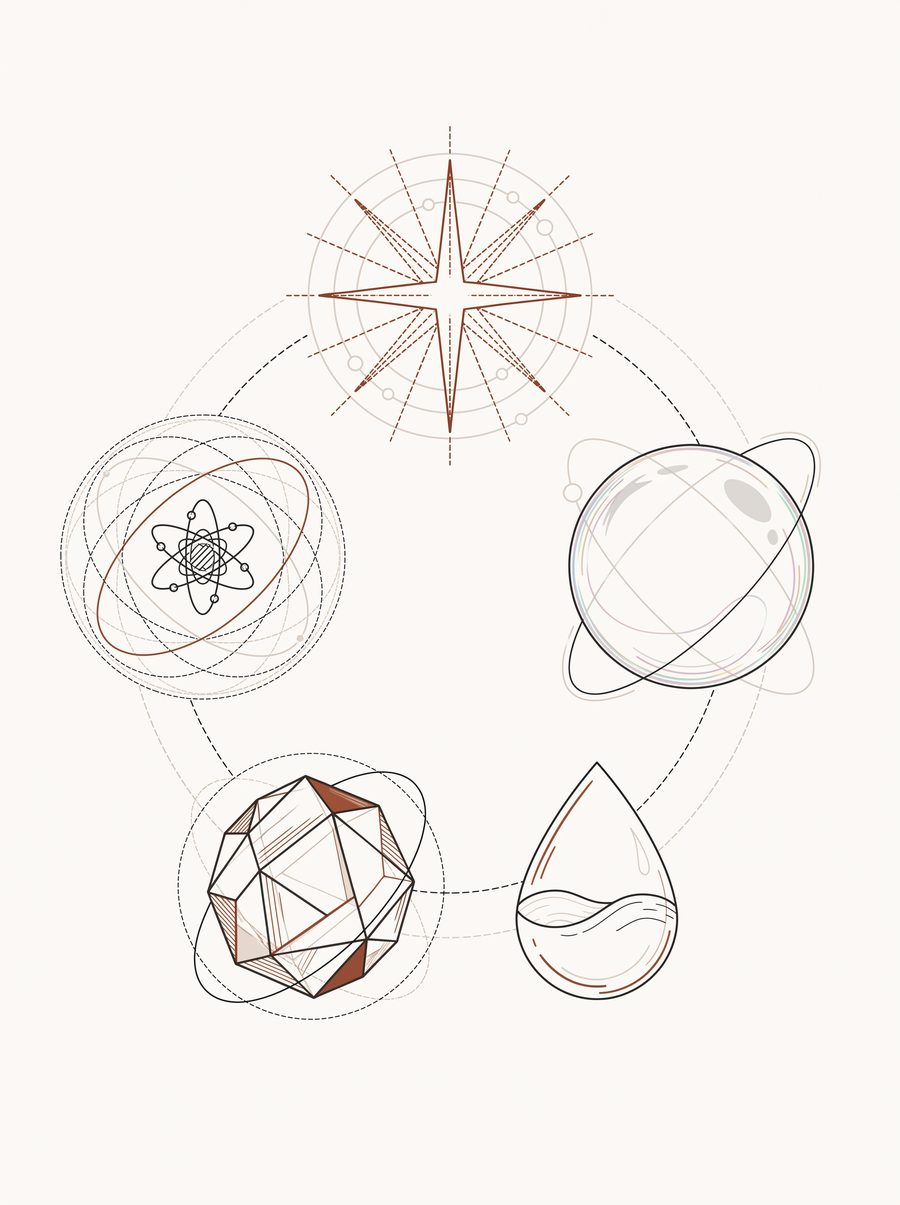
Generated via Gemini 3 Pro Image.
Stars, raindrops, fish eggs, pearls, and buckyballs have almost nothing in common — except that the same handful of physical mechanisms keeps shaping all of them into one shape. Objects that form as spheres, or very close approximations of one, span every scale from atoms to stars, and they get there by only a few distinct routes — not one single universal cause, but a short, real list of physically different mechanisms that happen to converge on the same geometry. Almost nothing macroscopic is a perfect mathematical sphere — rotation, irregularities, and external forces always leave some deviation, and several of the entries below are looser approximations than the headline examples suggest.
Four routes to the same shape
- Gravity (hydrostatic equilibrium) — acts toward a center of mass equally from every direction; given enough mass and enough time, the result wins over whatever irregular shape a body started with. The mechanism has two halves, and they are worth keeping separate because a single verb always hides one of them. The equilibrium shape is a gravitational equipotential — that is what selects a sphere. What mechanically erases a bump is pressure, pushing sideways out from under the high spot until no lateral difference is left to drive any more flow. Pressure does the work; the gravitational field sets the target. Worked through in full, with the derivation and real numbers, in What Rounds a Planet. (For a freely falling test particle, general relativity describes no force at all — see Gravity Doesn’t Pull — though a planet’s stressed interior is not that case, and its structure is ordinary Newtonian continuum mechanics.)
- Surface tension — minimizes surface area for a given volume. The sphere is the shape that packs the most volume into the least surface area, so anything governed by surface energy gets pulled toward one. The pull wording is kept here on purpose, and it is not an inconsistency with the entry above: surface tension genuinely is an attraction — liquid molecules cohering to their neighbors, directly measured — and it is the same agent that both sets the target shape and does the work of reaching it. Gravity’s case divides those two jobs between the potential and the pressure, as the entry above sets out. Two different mechanisms, two different descriptions.
- Isotropic growth or precipitation — building outward from a central point or nucleus with no preferred direction, whether that’s a mineral deposit, a cell, or a crystal lattice.
- Bonding geometry and quantum symmetry — a different kind of mechanism entirely, operating at the atomic and molecular scale (see below). Nothing here is “isotropic force” in the classical sense; a closed-shell atom’s spherical electron cloud is a quantum-mechanical symmetry, not a continuum-mechanics equilibrium — it converges on the same geometry for a genuinely different reason, not the same one applied at a smaller scale.
These are four physically distinct mechanisms, not one underlying cause wearing different costumes. What they share is only the outcome: whenever something acts equally in all directions, or whenever surface or bonding energy is being minimized, the sphere is where it ends up.
Astronomical and cosmic scale
- Stars, including the Sun and extreme cases like Kepler-11145123, one of the roundest stars ever measured
- Planets — approximately spherical, though many are slightly oblate from their own rotation
- Large moons and dwarf planets
- Large asteroids that reach hydrostatic equilibrium, such as Ceres
- Neutron stars and white dwarfs
- Black hole event horizons, spherical for the non-rotating case — worth flagging as a different kind of entry than the rest of this list: an event horizon isn’t a material object shaped by gravity acting on matter, it’s a geometric feature of spacetime itself in general relativity’s vacuum solutions. It’s included here because it’s still a case of a boundary determined by a perfectly isotropic (non-rotating) source, not because it formed the way a star or asteroid did.
Fluid and atmospheric objects
- Liquid droplets (water, oil, molten materials) — especially small droplets, or any droplet in microgravity
- Raindrops — small ones are nearly spherical; larger ones deform as they fall
- Air bubbles in liquids
- Hailstones — small ones are often close to spherical, though many real hailstones are irregular, lobed, or layered rather than round, since they grow through repeated up-and-down cycles inside a storm
- Naturally formed ice/snow balls shaped by wind and wave action, including the large spherical ice formations observed in Siberia
Geological and mineral objects
- Concretions — mineral masses that grow outward from a nucleus, including cannonball concretions, Moqui marbles (iron-oxide concretions), and septarian nodules
- Some geodes, in their outer form
- Oolites / ooids — small spherical sedimentary grains built from layered mineral coatings
- Spherulites — radial crystal-growth structures that are often spherical
Biological objects
- Spherical bacteria (cocci), such as Staphylococcus and Streptococcus
- Many, though far from all, pollen grains and fungal spores — plenty of pollen is spiked, ridged, or otherwise far from round; palynologists identify plant species partly because pollen shapes vary so much
- Eggs of many fish, amphibians, and invertebrates
- Vertebrate eyeballs, nearly spherical
- Certain colonial algae, such as Volvox
- Many free-floating single cells, including yeast
- Pearls, formed by mollusks
- Certain fruits and seeds that grow nearly spherical — oranges, tomatoes, cherries, grapes, blueberries, peas, and many other berries
Biology is the least clean-cut category here, and worth saying so plainly: unlike a soap bubble or a planet, a living organism’s shape is under genetic and developmental control, not simply the passive result of surface tension or uniform growth. A vertebrate eyeball stays round under active intraocular pressure regulation and tightly constrained optical development, not just because it grew evenly in every direction; fruit shape is driven by hormonal and genetic programs (and, for most familiar produce, generations of human selection) layered on top of whatever physical isotropy is present. Surface tension and uniform growth are real contributors in this category, not the whole explanation the way they are for a bubble or a mineral concretion.
Molecular and atomic scale
- Fullerenes, especially C₆₀ “buckyballs” — confirmed occurring naturally in soot, lightning discharges, and interstellar space; also reported in shungite rock, though shungite’s natural fullerene content has been disputed in the scientific literature and shouldn’t be taken as settled the way the other sources are
- Atoms with spherical electron clouds — closed-shell atoms or pure s-orbitals, a quantum-mechanical symmetry rather than a classical “isotropic force” in the sense the rest of this list uses
This scale is qualitatively different from everything above it, not just smaller: a bubble or a planet is a large number of particles settling into a shape under a classical force, while an atom’s spherical electron cloud is a single quantum system’s probability distribution, governed by the mathematics of angular momentum rather than anything pushing or pulling matter into place. It’s grouped here because it lands on the same geometry, not because it works the same way.
Summary of drivers
| Scale | Primary force / mechanism | Examples |
|---|---|---|
| Cosmic | Gravity | Stars, planets, moons |
| Fluid | Surface tension | Droplets, bubbles, small hail |
| Geological | Isotropic mineral precipitation | Concretions, oolites, Moqui marbles |
| Biological | Uniform growth + surface tension | Cocci, spores, pollen, eggs, pearls |
| Molecular | Bonding geometry / quantum symmetry | C₆₀, spherical atoms |
Four different mechanisms, converging on one shape whenever something acts equally in all directions or minimizes surface/bonding energy — real physical causes, not one underlying law wearing different costumes.
Solid spheres, and the direction they grow
Most of the catalog above is sphere-shaped rather than sphere-solid. A soap bubble is a film around trapped gas; an air bubble is a void; a geode is a shell around a cavity; an atom’s electron cloud isn’t a material body at all. Narrowing to objects that are genuinely solid all the way through leaves a much shorter list — and asking how that solid interior actually got there turns out to be a more interesting question than the shape itself.
- Geological concretions — mineral-rich groundwater seeps through soft sediment and precipitates a cement (commonly calcite, silica, or iron oxides) around a small nucleus such as a shell, a fossil fragment, or a sand grain. The cement grows outward in roughly equal directions, producing a solid mass of rock. When the softer surrounding rock later erodes away, these “cannonball concretions” are left standing free — marble-sized up to several meters across, in the North Dakota Badlands, Rock City in Kansas, Utah’s Ferron Sandstone, and the Valley of Balls (Torysh) in Kazakhstan, among many other places. Moqui marbles are the iron-oxide variety weathering out of Utah’s Navajo Sandstone. The Klerksdorp spheres from South African pyrophyllite deposits belong here too, and are worth naming explicitly because they circulate widely as claimed manufactured artifacts: the geological reading is that they are ordinary natural mineral growths, and that is the mainstream interpretation, not a dismissal of an open question.
- Pearls — a mollusk’s mantle tissue secretes successive thin layers of nacre (aragonite plus an organic matrix) around an irritant. Solid and layered throughout. Genuinely spherical natural pearls are rare; most flawlessly round pearls on the market are cultured, but the natural process is real.
- Oolites / ooids — tiny grains, well under 2 mm, built from concentric calcium-carbonate layers precipitated onto a nucleus while being rolled in shallow, agitated marine or lake water. They accumulate into oolitic limestone. Solid mineral spheres by purely inorganic precipitation.
- Hailstones — an ice embryo grows as supercooled droplets freeze onto its surface, leaving internal growth rings. Solid ice, though (as noted above) larger stones are frequently lobed or irregular rather than round.
- Planetary bodies — dust, rock, and ice accrete under gravity; once a body is massive enough for self-gravity to overcome the material strength of its own rock or ice (roughly hundreds of kilometers across), hydrostatic equilibrium reshapes it into a near-sphere. Not perfect mathematical spheres, but large solid ones.
Accretion, not absorption
The distinction worth pulling out: every one of these grows by material being added from the outside — precipitation, biological secretion, freezing, or gravitational accretion. None of them forms by absorption, in the sense of a pre-existing body drawing material inward into its own volume the way a sponge soaks up water. The sphere is built up layer by layer or radially outward from a nucleus; it is not a pre-formed shape that fills in.
The one case that superficially looks otherwise is a concretion, which does incorporate the surrounding sediment grains it cements. But even there the process is the cemented mass growing outward through previously loose material, not a finished shape absorbing anything into itself. The nucleus came first and the sphere grew around it.
Two exclusions, for the same reason:
- Rounded river and beach stones approach sphericity through abrasion, but that’s erosional reshaping of pre-existing rock — subtraction, not primary formation of a solid sphere. Different mechanism entirely from everything above.
- Perfect mathematical spheres, as flagged at the top of this entry, aren’t on the table at all — every object here is solid and spherical for practical purposes, not exactly.
Where this touches PBT
Everything cataloged above is standard, independently confirmed science — that’s the entire content of this entry. Pressure-Based Theory (PBT) is this site’s own unproven, still-under-development alternative theory of gravity, not part of that established record, and nothing above depends on it or is evidence for it. The one thing worth noting plainly: PBT’s own proposed mechanism for gravity — matter pushed toward a center by pressure from a hypothesized isotropic particle medium (see the theory and Why Pressure) — happens to describe an isotropic-force process, the same broad category as ordinary gravity and surface tension in the list above. That’s a superficial resemblance in form, not a validation of PBT, not evidence PBT is correct, and not a claim that PBT explains any of the real physics cataloged here — actual stellar and planetary sphericity is fully accounted for by ordinary Newtonian/GR gravity, with no need for PBT’s proposed mechanism at all. See Recognizing Similarities in the Universe for a related look at bubbles and planets, under the same caveat.
The accretion-versus-absorption distinction in the section above deserves one more note, because it is the kind of thing that could easily be oversold here. It does not discriminate between PBT and ordinary gravity. PBT proposes a different cause for the force driving gravitational accretion — matter pushed inward by an external isotropic medium rather than pulled toward a center of mass — but under either account, material still arrives from outside and is added to the growing body. “Grown by addition from the outside, not by absorption inward” is an observational fact about how material actually moves during sphere formation, and it holds identically whichever gravity mechanism turns out to be correct. It is not evidence for PBT, and no weight should be put on it as such.
Catalog status: Proven Systems
Hydrostatic equilibrium, surface tension, and the sphere-forming mechanisms cataloged above are long-settled, independently confirmed science — nothing in this entry is a novel or disputed claim.
See also
- Soap Bubbles in Air, Air Bubbles in Water, and Water Droplets in Air — the fluid-scale row of the table above, worked out in full DOE-parameter detail
Built from a conversation with Grok, xAI, on natural sphere-forming objects. The “Solid spheres, and the direction they grow” section was added 2026-07-30 from a follow-up conversation narrowing the question to spheres that are solid throughout, and to whether they grow by accretion or by absorption.
Rev 2 — 2026-08-06. The gravity entry in “Four routes to the same shape” was reworded away from “pulls matter equally toward a center of mass.” The surface-tension entry deliberately keeps its “pulled” wording, because cohesion between liquid molecules genuinely is an attraction.
Rev 3 — 2026-08-06, same day, correcting Rev 2 rather than replacing it. Rev 2 stated that “the round shape is set by a pressure balance.” That is wrong, and the correction matters. An adversarial review pass on a companion article caught it, and it was verified independently before being accepted: taking the curl of the hydrostatic condition $\nabla P = -\rho\nabla\Phi$ gives $\nabla\rho \times \nabla\Phi = 0$, so $P = P(\Phi)$ — surfaces of constant pressure coincide with gravitational equipotentials. The equilibrium shape is therefore selected by the potential, not by the pressure; pressure is the mechanism that relaxes a fluid onto that surface. Setting $g = 0$ leaves $dP/dr = 0$ and no body at all, so gravity is the source term rather than an incidental factor. Rev 2 also asserted the condition is called hydrostatic equilibrium “rather than anything about attraction,” which was a word game on the symbol $g$ — that is the gravitational body force per unit mass. Both claims are withdrawn. The Catalog status is unchanged, and the PBT caveat still stands: none of this invokes or supports PBT’s proposed shadow-push mechanism.