Water Droplets in Air: Conditions for Formation and Sustainment
July 2026
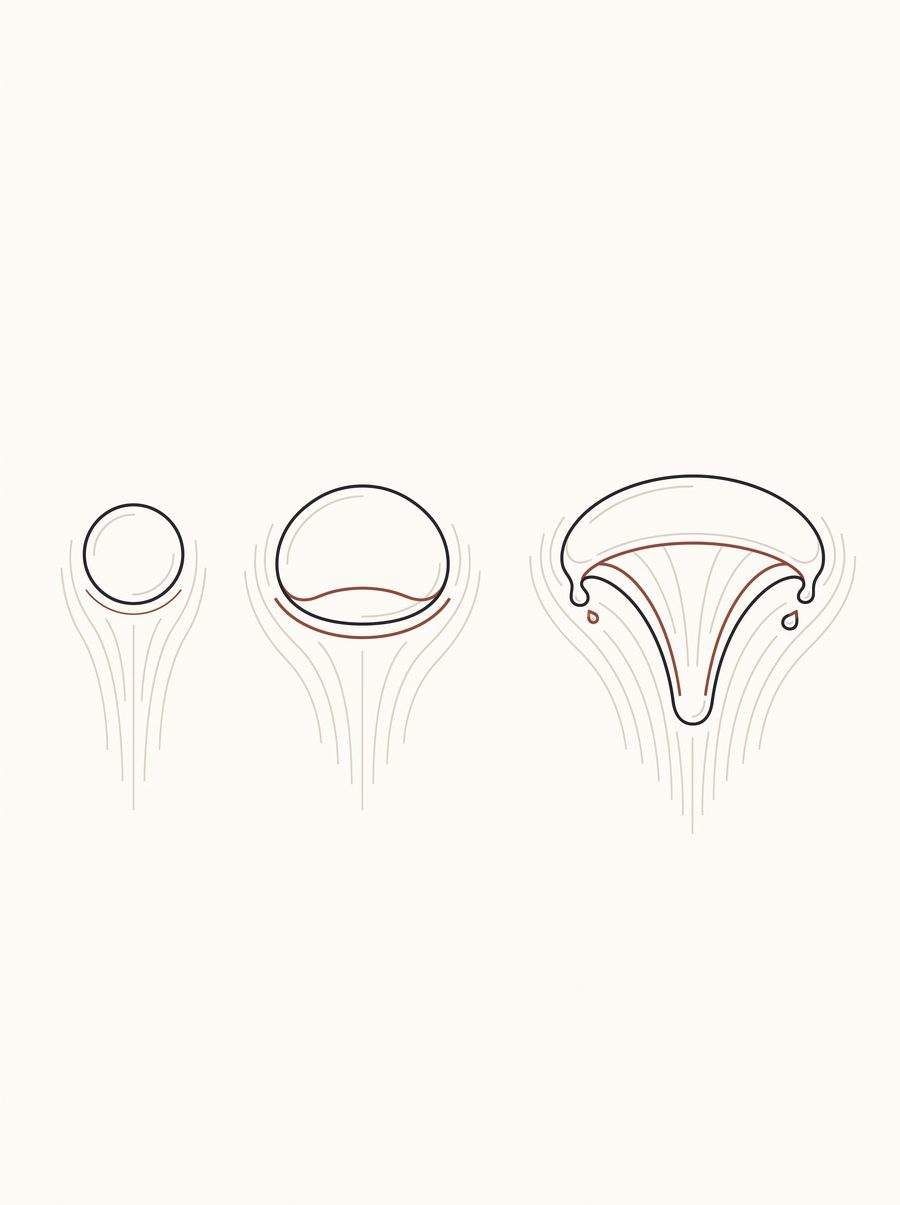
Generated via Gemini 3 Pro Image.
A raindrop, a fog droplet, and the mist off a waterfall are all the same basic object: a sphere of liquid water suspended in air, held together by the same surface tension that shapes a soap film or a floating gas bubble — just with the phases reversed. Where a gas bubble in water is a pocket of low-density gas inside a dense liquid, a water droplet in air is a pocket of dense liquid inside a low-density gas. That reversal changes almost everything about how it forms, how long it lasts, and how it dies.
Why it’s a sphere, until it isn’t
The same logic as every other entry in this section applies here first: surface tension pulls the droplet toward the smallest possible surface area for its volume, and a sphere is that shape. For small droplets — fog, mist, drizzle, and raindrops well under a millimeter — surface tension dominates and the droplet is very close to spherical, though even at this scale it’s an excellent approximation, not a mathematically perfect one.
That approximation gets worse as a raindrop grows. Real raindrops are not the teardrop shape they’re almost always drawn as — a falling drop starts out close to spherical while small, then flattens on its underside into something closer to a hamburger bun as aerodynamic pressure builds against it, with measurable deformation setting in well before a millimeter. Push a drop past roughly 4–5 mm in diameter (the practical breakup range — some sources place the hard limit closer to 4mm, others allow up to about 5mm in unusually calm air) and the flattening goes further: the base caves upward into a concave pocket, the drop becomes a thin, parachute-like bag of water, and it tears itself apart — real, documented breakup physics (bag breakup, with Rayleigh-Taylor instability of the flattened base as one contributing mechanism among others), not just “it got too heavy.” Surface tension builds the sphere; at large enough size, aerodynamic drag is what ends it.
The pressure balance
Like an air bubble in water, a water droplet in air has a single interface, so the Young-Laplace relation takes the same form:
$$\Delta P = P_{\text{inside (water)}} - P_{\text{outside (air)}} = \frac{2\gamma}{r}$$
with $\gamma$ the water-air surface tension and $r$ the droplet radius — the same equation as the water-bubble case, just with the liquid now on the inside instead of the outside. Because $\Delta P$ scales as $1/r$, this pressure difference is enormous for a fog droplet and nearly nothing for a raindrop:
| Droplet radius | Example | $\Delta P = 2\gamma/r$ (at $\gamma \approx 72.8$ mN/m) |
|---|---|---|
| 1 µm | fine mist | ~146 kPa (~1.4 atm) |
| 10 µm | typical cloud droplet | ~14.6 kPa (~0.14 atm) |
| 100 µm | drizzle | ~1.5 kPa (~0.014 atm) |
| 1 mm | small raindrop | ~146 Pa (~0.0014 atm) |
| 2.5 mm | large raindrop (near breakup) | ~58 Pa (~0.0006 atm) |
Two kinds of molecular motion, roles reversed
Inside a water droplet, the liquid molecules genuinely do have a real, equipartition-driven instantaneous speed of several hundred m/s (~615–660 m/s at everyday temperatures) — that’s not a naive number to be waved away. What’s actually slow is how far that motion carries a molecule: packed against its neighbors with almost no room to move freely, its net displacement — the diffusive rate that governs how the droplet actually evaporates or exchanges with the vapor around it — is more like 0.1–10 m/s. Surrounding the droplet on every side, the air molecules are moving at roughly 485–520 m/s and covering real distances between collisions, not just vibrating in place. This is the same distinction from Soap Bubbles in Air and Air Bubbles in Water, showing up a third time with the fast and slow phases swapped to the opposite sides of the interface: it was never really about one phase’s molecules being intrinsically faster, but about how far each one gets to travel before something gets in the way.
Conditions for formation and sustainment
| Parameter | Min | Nominal | Max | Units | Notes / role in sustainment |
|---|---|---|---|---|---|
| Air temperature | 0 | 20 | 40 | °C | Sets air molecular speed and the water-vapor capacity of the surrounding air (warmer air holds more vapor before reaching saturation). |
| Air molecular speed (rms) | ~485 | ~500 | ~520 | m/s | Set by temperature and molecular mass, same as the companion bubble entries. |
| Air molecular size (kinetic diameter) | 0.346 (O₂) | 0.36 | 0.364 (N₂) | nm | Fixed for ordinary air. |
| Water (droplet) temperature | ~–40 (supercooled) | 15–20 | ~100 | °C | Below 0 °C the droplet is metastable (“supercooled”) rather than truly stable — common in real clouds down to about –15 to –20 °C, with spontaneous freezing (homogeneous nucleation) essentially guaranteed by about –40 °C. Above 100 °C at 1 atm, liquid water flashes to vapor rather than existing as a droplet at all. |
| Water molecular size (kinetic diameter) | 0.265 | 0.28 | 0.30 | nm | Fixed property of H₂O. |
| Water molecular speed — instantaneous (equipartition) vs. effective (diffusive) | ~0.1–10 (diffusive) | ~615–660 (equipartition estimate) | ~700 (diffusive, upper bound) | m/s | Same liquid-phase motion as the water-bubble entry — it’s the identical substance, just on the other side of the interface this time. Both numbers are real; they answer different questions (instantaneous speed vs. net displacement). |
| Surface tension (water-air), $\gamma$ | ~58–60 (near 100 °C) | 72–73 | ~75–76 (near 0 °C) | mN/m | Falls with rising temperature; the higher it is, the more strongly the droplet resists deformation and breakup. |
| Droplet radius, $r$ | ~1–10 µm (fog / cloud droplet) | ~0.5–1 mm (drizzle to typical raindrop) | ~2–2.5 mm (near the ~4–5 mm breakup diameter) | µm or mm | The single biggest lever on everything else — $\Delta P$, fall speed, and lifetime all move together with $r$. |
| Pressure difference, $\Delta P = 2\gamma/r$ | ~50 Pa (large raindrop) | ~150 Pa (1 mm raindrop) | ~150 kPa (1 µm mist) | Pa (atm shown per cell above) | See the size table above — microscale mist droplets carry atmosphere-scale internal pressure; raindrops carry almost none. |
| Terminal fall velocity | ~1 cm/s (10 µm cloud droplet, Stokes’ law regime) | ~4–8 m/s (1–2 mm raindrop) | ~9–10 m/s (largest stable raindrops, ~4–5 mm) | m/s | Cloud droplets fall so slowly that ordinary air turbulence keeps them suspended — this is literally what makes a cloud a cloud instead of instant rain. Above the ~4–5 mm breakup diameter, terminal velocity stops increasing at all, since the drop shatters first. |
| Relative humidity of surrounding air | undersaturated (net evaporation) | saturated (equilibrium) | mildly supersaturated (net growth) | %RH | The direct water-vapor analogue of the water-bubble entry’s gas-saturation row, and the single most important factor for lifetime. Undersaturated air evaporates a droplet — sometimes before it even reaches the ground, the real phenomenon meteorologists call virga. Saturated air holds a droplet in equilibrium, which is why clouds persist instead of vanishing on the spot. Supersaturated air (usually via condensation nuclei — dust, salt, pollution particles) drives net growth, the mechanism behind cloud droplets coalescing into rain in the first place. |
| Ambient (hydrostatic) pressure | ~0.5–0.7 atm (mid-altitude cloud layers, ~3–5 km) | ~1 atm (sea level) | slightly above 1 atm (below-sea-level locations) | atm | Sets the baseline the droplet’s own $\Delta P$ is added to or measured against; has little direct effect on droplet stability itself compared to humidity and temperature. |
Key limits for sustainment
- Radius is the parameter everything else follows: small enough (µm-scale, cloud/fog droplets) and the droplet is essentially weightless in air, held aloft indefinitely by ordinary turbulence as long as the air stays saturated. Large enough (past ~4–5 mm) and surface tension can no longer hold the shape together against aerodynamic drag at all, regardless of anything else in this table.
- Relative humidity is the real long-term deciding factor, the same role gas saturation plays for a water bubble — saturated or supersaturated air is the only condition under which a droplet doesn’t slowly evaporate away.
- Temperature sets both the liquid-existence window (roughly –40 °C to 100 °C, with 0–20 °C the everyday range) and, through the vapor-capacity of the surrounding air, how much moisture is available to keep a droplet from evaporating.
- Nothing here produces true indefinite existence for a macroscopic droplet, the same real limit as the water-bubble entry — a raindrop either reaches the ground, evaporates first (virga), or breaks apart in flight; only cloud-scale droplets suspended in saturated, turbulent air come close to a genuinely long-lived steady state, and even that state is dynamic (droplets constantly forming and evaporating within the cloud) rather than any single droplet lasting forever.
Where this touches PBT
Everything above — raindrop physics, Stokes’ law, and Young-Laplace curvature pressure — is standard, independently confirmed science, and none of it depends on or is evidence for Pressure-Based Theory (PBT), this site’s own unproven alternative theory of gravity. The recurring note from this section’s other two entries applies a third time, stated as narrowly as it deserves: $\Delta P = 2\gamma/r$ shares the same broad category of explanation — pressure balance rather than an attractive force — as PBT’s own proposed gravity mechanism (see the theory and Why Pressure). That’s a resemblance in the shape of the explanation, and nothing more: Young-Laplace pressure is a rigorously derived, experimentally confirmed consequence of intermolecular attraction and interface curvature, while PBT’s mechanism remains a hypothesized medium without comparable confirmation. Droplet evaporation and breakup are fully explained by ordinary thermodynamics and fluid drag — nothing here needs, uses, or supports PBT’s proposed medium.
Catalog status: Proven Systems
Raindrop physics, Stokes’ law fall speeds, and the Young-Laplace pressure relation are long-settled, independently confirmed science — nothing in this entry is a novel or disputed claim.
See also
- Air Bubbles in Water — the phase-reversed counterpart: gas inside liquid instead of liquid inside gas
- Soap Bubbles in Air — the two-surface-film case, for comparison against this single-interface one
- Spheres in Nature — the broader catalog this entry’s sphericity belongs to
Compiled independently — not from a Grok conversation this time — from standard kinetic theory, fluid mechanics, and atmospheric physics, following the same DOE-parameter format as the companion bubble entries. Key figures independently checked against current research before publishing: raindrop terminal velocity and breakup diameter (Beard 1976’s finding that drops beyond ~4 mm break apart from aerodynamic instability, with a practical upper limit of ~4–5 mm), cloud-droplet Stokes’ law fall speed (derived directly here: a 10 µm-radius droplet works out to ≈1.2 cm/s, matching the standard ~1 cm/s figure for cloud droplets), and the ~–40 °C homogeneous-nucleation limit for supercooled water.