What Is Infinity Plus Ten?
October 2026
Original post: @LongFormMath on X, 16 Oct 2026. If the embed above doesn’t load, everything it showed is written out below.
Infinity plus ten is still infinity, if you’re counting how many things there are. It’s something genuinely larger, if you’re counting a position in an endless line. Both answers are real; they just answer two different questions. Mathematicians worked out exactly how to tell those questions apart only in the late 1800s, after roughly two thousand years of debating infinity in vaguer, more philosophical terms.
On 16 October 2026, mathematician and author Jay Cummings (@LongFormMath) posted that his son had asked him what infinity plus ten equals, and that he had been training for this moment his whole life. The post passed 700,000 views within its first day.
When someone demanded his answer, he replied with a joke syllabus: bijections, cardinality, countable versus uncountable sets, Cantor’s diagonal argument, Hilbert’s Hotel, ordinal arithmetic, transfinite induction, the aleph hierarchy, the axiom of choice and Zorn’s lemma. The continuum hypothesis, he said, would wait until morning so the boy wouldn’t have bad dreams.
That list is the broader landscape professional mathematicians use to think about infinity. Only two pieces of it actually answer his son’s question: cardinal arithmetic and ordinal arithmetic. Everything else on the list, the diagonal argument, choice, Zorn’s lemma, the continuum hypothesis, is real and worth knowing, but it settles different questions than the one his son asked. Walk the two pieces that answer the question first, then the wider landscape the joke was pointing at.
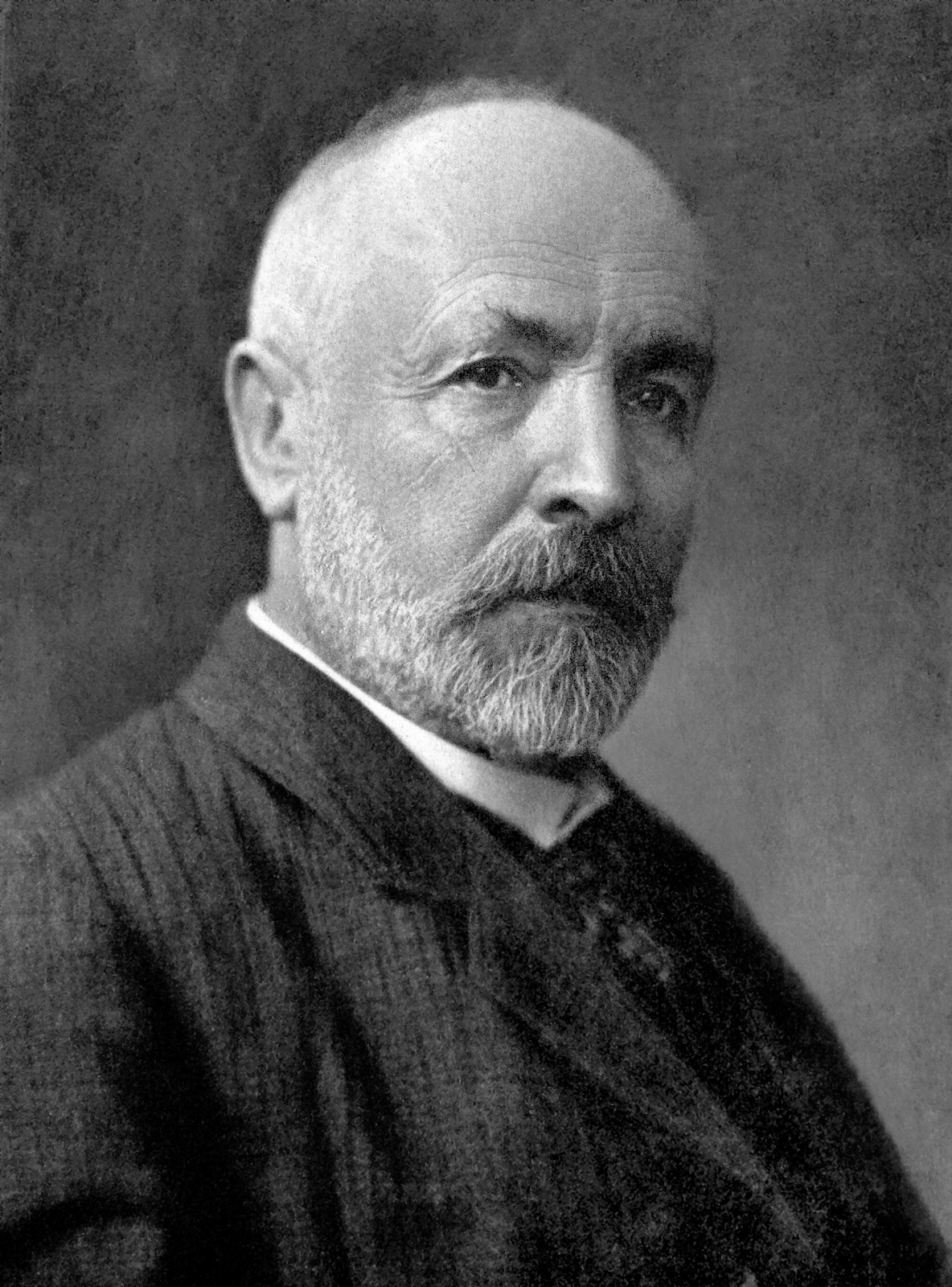
Georg Cantor, the mathematician whose 1870s insight — trusting the pairing rule below even for sets that never end — is where this whole story starts. Photo circa 1910, public domain.
Counting without numbers
Two sets are the same size if you can pair their members off perfectly, with nobody left over. That pairing is called a bijection, and it is how mathematicians compare infinities.
A child does this before learning to count. Put one cookie on each plate; if every plate has a cookie and every cookie has a plate, there are as many cookies as plates. You never needed the number.
Georg Cantor’s insight in the 1870s was to trust this rule even when the sets never end. The size a bijection measures is called a set’s cardinality. The result is strange immediately:
- The even numbers pair with all natural numbers: 1↔2, 2↔4, 3↔6, and so on. So there are exactly as many evens as naturals.
- The integers pair with the naturals too: 0, 1, −1, 2, −2, … lists every one.
- The fractions can be listed too: walk a grid of numerator/denominator pairs diagonally, and skip any fraction already listed in lower terms. Every fraction eventually gets a number, and none gets two.
A part can be as big as the whole. For infinite sets, that is not a paradox. It is practically the definition.
Hilbert’s Hotel: always room for more
A full hotel with infinitely many rooms can always take more guests. David Hilbert used this image in an unpublished lecture series at Göttingen over the winter of 1924–25, to make bijections feel physical. It stayed a classroom story for two decades. George Gamow retold it in his 1947 book One Two Three… Infinity, and that’s actually how most people have heard it since.
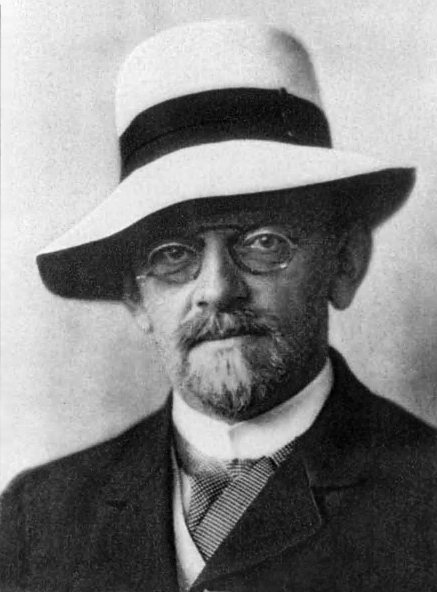
David Hilbert, whose unpublished 1924–25 lecture series is where the hotel story below actually comes from. Photo pre-1912, public domain.
Every room, numbered 1, 2, 3, …, is occupied. The manager never turns anyone away; he just reassigns rooms.
| Who arrives | The manager’s rule | What it shows |
|---|---|---|
| 1 new guest | Guest in room n moves to n + 1; room 1 is free | ℵ₀ + 1 = ℵ₀ |
| 10 new guests | Guest in room n moves to n + 10 | ℵ₀ + 10 = ℵ₀ |
| A bus with infinitely many passengers | Guest in room n moves to 2n; passenger k takes room 2k − 1 | ℵ₀ + ℵ₀ = ℵ₀ |
| Infinitely many buses, each full | Guest in room n moves to 2ⁿ; passenger s (s ≥ 1) on bus k takes room (p_k)^s, where p_k is the kth odd prime | ℵ₀ × ℵ₀ = ℵ₀ |
The last trick relies on the fundamental theorem of arithmetic: every number factors into primes in only one way, so no two people ever share a room. It does leave many rooms empty, such as 6 and 15, but nobody is turned away.
So here is the first answer to the five-year-old, and the only one his actual question needs. If infinity means “how many counting numbers there are,” infinity plus ten is the same infinity. Ten more guests fit without anyone noticing, and nothing past this point changes that answer.
The bus the hotel cannot hold
Everything above already answers the question as asked. What follows is the wider landscape Cummings’s joke gestures at: infinities bigger than others, a question with no answer at all, and an axiom mathematicians still argue about. None of it is required to answer his son; it’s where the syllabus goes if you keep going.
Some infinities are bigger than others. Cantor proved that first in 1874, using a method built from nested intervals. The version almost everyone actually learns today is his simpler, later proof: the 1891 diagonal argument, short enough to fit on a napkin.
Imagine a bus whose passengers are named by every infinite string of 0s and 1s. Suppose the manager claims he has given each one a room. Write the list out, room by room:
| Room | Passenger’s name |
|---|---|
| 1 | 0 1 1 0 1 … |
| 2 | 1 1 0 0 1 … |
| 3 | 0 0 0 1 1 … |
| 4 | 1 0 1 1 0 … |
Now build a new name by walking down the diagonal and flipping each bold digit: 1, 0, 1, 0, …. This name differs from room 1’s guest in the first digit, from room 2’s in the second, and from every guest somewhere. So that passenger has no room. The list was never complete, and no list ever can be.
That bus of endless 0-and-1 strings is essentially the real numbers in disguise. Every point on the number line between 0 and 1 has a binary expansion, an endless string of 0s and 1s, with only a harmless handful of numbers getting two expansions instead of one. The same diagonal argument shows the reals are uncountable too.
Sets that can be listed, like the naturals, integers and fractions, are countable, with size ℵ₀ (aleph-null). Sets that cannot, like the real numbers on a number line, are uncountable. Their size is written 𝔠, for continuum, and equals 2^ℵ₀.
Cantor went further: for any set, the set of all its subsets is strictly bigger. So there is no largest infinity. Above every infinity sits another.
So what is infinity plus ten, really?
A five-year-old asking what infinity plus ten equals is almost certainly asking how many, not what position in a line. For that question, there’s one answer, and it’s the hotel’s answer: ℵ₀ + 10 = ℵ₀.
There’s a second, different question mathematicians also study, using a different kind of infinite number. Picture a queue: 1st, 2nd, 3rd, and on forever. The position right after all of them is called ω (omega). Put ten more people at the very back of that queue, after every one of the infinitely many people already in it. They stand in positions ω, ω + 1, …, ω + 9, positions nobody held before: ω + 10 comes strictly after ω.
That doesn’t make the new line bigger. Count the people instead of their position, and there are still exactly ℵ₀ of them; ω + 10 and ω have the same cardinality even though they aren’t the same ordinal. The two number systems answer different questions about the same line, and that’s the real lesson here, not that infinity plus ten has two equally good answers depending on taste.
\omega + 10 > \omega \qquad\text{but}\qquad 10 + \omega = \omega
Put the ten at the front instead, and they simply become the first ten places of an endless queue. Nothing new appears at the end, and even the position collapses back to where it started: 10 + ω = ω.
Ordinal addition does not commute: order matters. The ordinals keep going, through ω·2, ω², ω^ω and far beyond. Proving facts about all of them uses transfinite induction: show a claim survives each next step and each limit like ω, and it holds all the way up.
So the answer for a five-year-old is the first one: still infinity, if you’re counting things. If anyone ever asks about position in a queue instead, that’s a different question, and infinity plus ten moves you ten places further down it.
A ladder of alephs, and a contested axiom
The infinite cardinals form a ladder: ℵ₀, ℵ₁, ℵ₂, …, each the next size up. ℵ₀ is the smallest infinity; ℵ₁ is the smallest one bigger than it; and the ladder never ends.
To be sure every infinite set lands somewhere on that ladder, you need the axiom of choice. It says that given any collection of non-empty boxes, you can pick one item from each, even infinitely many boxes with no rule for choosing. Bertrand Russell’s illustration: from infinitely many pairs of shoes you can always take the left shoe, but from infinitely many pairs of socks you need the axiom.
Choice is equivalent to two other statements, which mathematicians use as tools:
- The well-ordering theorem: every set can be arranged into a queue, so every set has a place on the aleph ladder.
- Zorn’s lemma: if every chain in an ordered collection has an upper bound, the collection has a maximal element. It is how algebra proves every vector space has a basis.
Choice also has strange consequences. Banach and Tarski showed in 1924 that it lets you cut a solid ball into finitely many pieces and reassemble them, using only rotations and translations, into two balls each the same size as the first. Raphael Robinson tightened that in 1947 to the minimum possible: five pieces, and no fewer will do. Kurt Gödel showed in 1938 that choice is consistent with the other standard axioms; Paul Cohen showed in 1963 that its denial is too. So the standard axioms can neither prove nor disprove it, and most mathematicians accept it anyway; the five-year-old’s struggle with Zorn’s lemma is entirely understandable.
The question saved for morning
Is there an infinity between the counting numbers and the points on a line? That is the continuum hypothesis, and it has no answer from the standard axioms at all.
Cantor guessed no: that 𝔠 = ℵ₁, the very next rung. He spent years trying to prove it. Hilbert put it first on his famous 1900 list of problems. Kurt Gödel showed in 1940 that assuming the hypothesis never leads to a contradiction; Paul Cohen showed in 1963 that assuming its opposite doesn’t either, winning a Fields Medal for it. Mathematics can be built either way, and set theorists still argue about which universe is the true one.
That may be the most unsettling idea here: some questions about infinity are undecidable. No future proof will ever resolve them from the standard axioms alone. Probably best left until after breakfast.
And infinity minus infinity?
In the same thread, another parent said his six-year-old had asked what infinity minus infinity is. The answer: it isn’t defined, because it could be anything.
Take all the counting numbers and remove all the even ones: infinitely many are left. Remove all of them: zero are left. Remove all but the first ten: ten are left. In each case you took infinity from infinity, and the answer changed. Subtraction breaks where addition still worked.
The lesson for bedtime
Infinity is not one very large number. It is a whole family of sizes and positions, with rules of its own. The actual answer to “infinity plus ten” only needed Cantor’s cardinal and ordinal arithmetic, worked out by the 1890s. Ten more fit in the hotel without trouble, ten more at the back of an endless line make something new, and some questions about infinity, like the continuum hypothesis, have no answer at all. Everything past that, Zorn’s lemma, Gödel, Cohen, is the deeper landscape his dad’s joke was pointing at, not the price of admission.
Which is still a lot for a five-year-old.
Where this shows up beyond the hotel
None of this is just a classroom exercise. Calculus, probability theory, and physics all lean on exactly the cardinal and ordinal machinery above to handle quantities that genuinely have no largest value. Whether infinity is only a tool inside the math, or something the physical universe itself actually contains, is a separate, open question. This project’s own Embracing Infinity takes that question on directly, starting from the same mathematical facts as this piece, and asking whether space, time, and scale in the real universe might be genuinely infinite rather than just very large.
Sources: Jay Cummings on X, 16 Oct 2026, and the replies in that thread, read via the X API. Cantor’s two uncountability proofs: “On Cantor’s Uncountability Proofs” and the “Cantor’s first set theory article” entry on Wikipedia, cross-checked against each other. Hilbert’s Hotel: Helge Kragh, “The True (?) Story of Hilbert’s Infinite Hotel”, arXiv:1403.0059. Gödel and Cohen on choice and the continuum hypothesis: the Stanford Encyclopedia of Philosophy’s entries on Gödel and on the continuum hypothesis. Banach–Tarski and Robinson’s five-piece refinement: the Banach–Tarski paradox’s own citation record. Jay Cummings’s background: his author page at longformmath.com.
Image credits
- Georg Cantor portrait: Wikimedia Commons, public domain.
- David Hilbert portrait: Wikimedia Commons, public domain.


Revision History
This is a standing work, revised as the underlying understanding improves rather than fixed at publication. Every substantive change is logged here, most recent first.
| Rev | Date | Change | By |
|---|---|---|---|
| 2 | 2026-10-17 | Added a cross-link to Embracing Infinity, this project’s own piece on whether infinity shows up in the physical universe rather than only on a number line. | Matthew Foutch / Claude |
| 1 | 2026-10-17 | Original publication. | Matthew Foutch / Claude |